Axis Bank fair value — is it overvalued?
The fair value of Axis Bank (AXISBANK), built from its filed accounts — ten years of results, the method that fits this business, and what today's price already assumes.
The market expects Axis Bank to carry on much as it has.
At today’s share price, buyers are assuming Axis Bank earns about 14% a year on the money invested in it, from here on. Over the last ten years it actually earned about 14.3% a year. The two are close, so the share price does not need the business to improve or to stumble. It needs it to keep doing roughly what it already does.
What the market is assuming
Worked backwards from today's share price: the return on equity today’s price implies for Axis Bank, against what the model assumes.
How to read this. The number on the left is the return on equity today’s share price quietly takes for granted. The number on the right is what the model actually assumes. When the two are far apart, that gap is the bet you would be taking.
Ten years, in charts
Revenue and earnings per share in ₹, return on equity and leverage as ratios — all from the filed statements.
The numbers behind them
Revenue and net profit as filed, in ₹ crore.
| Year | Revenue | Net profit | Margin |
|---|---|---|---|
| FY2019 | 70,232 | 5,047 | 7.2% |
| FY2020 | 80,058 | 1,879 | 2.3% |
| FY2021 | 80,848 | 7,252 | 9.0% |
| FY2022 | 86,114 | 14,164 | 16.4% |
| FY2023 | 1,06,155 | 10,853 | 10.2% |
| FY2024 | 1,37,989 | 26,424 | 19.1% |
| FY2025 | 1,55,917 | 28,112 | 18.0% |
| FY2026 | 1,62,212 | 26,494 | 16.3% |
How this company gets valued — and why
A bank is not valued with a discounted cash flow. Deposits are its raw material and interest is operating income, so enterprise value means nothing here. It is valued on excess return instead — the profit it earns above the cost of the equity funding it.
Excess return — the correct lens for a bankUnderstand this method
- How to Value a Bank Stock in India
- Price-to-Book Explained: The Right Way to Value a Bank
- ROCE and ROE Explained: The Two Ratios That Reveal Quality
- How every one of our bank stocks is valued
The complete valuation
Unlock the complete valuation report
- ✓Fair value per share — with the full working behind it
- ✓Bull, base and bear cases — and what moves between them
- ✓Every assumption — growth, margins, cost of capital, with sources
- ✓Peer comparison — how rivals are priced on the same measures
- ✓Downloadable PDF report — the full write-up, yours to keep
Compare with peers
The same valuation, run side by side.
Axis Bank vs ICICI BankThe closest private-bank comparison on size and mix.→Axis Bank vs HDFC BankThe largest private bank, on the same measures.→Axis Bank vs Kotak Mahindra BankSmaller book, historically higher margins.→Frequently asked
Is Axis Bank overvalued?
At ₹1,257 the market is pricing in roughly 14.0% sustained ROE, against the ~14.3% its own record supports. That is close to what it has delivered, so the price is broadly consistent with the company simply continuing as it has.
What is the intrinsic value of Axis Bank?
It is computed from the filed financial statements using the method that fits this business (excess return), with every assumption shown alongside the result. The per-share figure and the full working are in the report.
Is Axis Bank a good long-term investment?
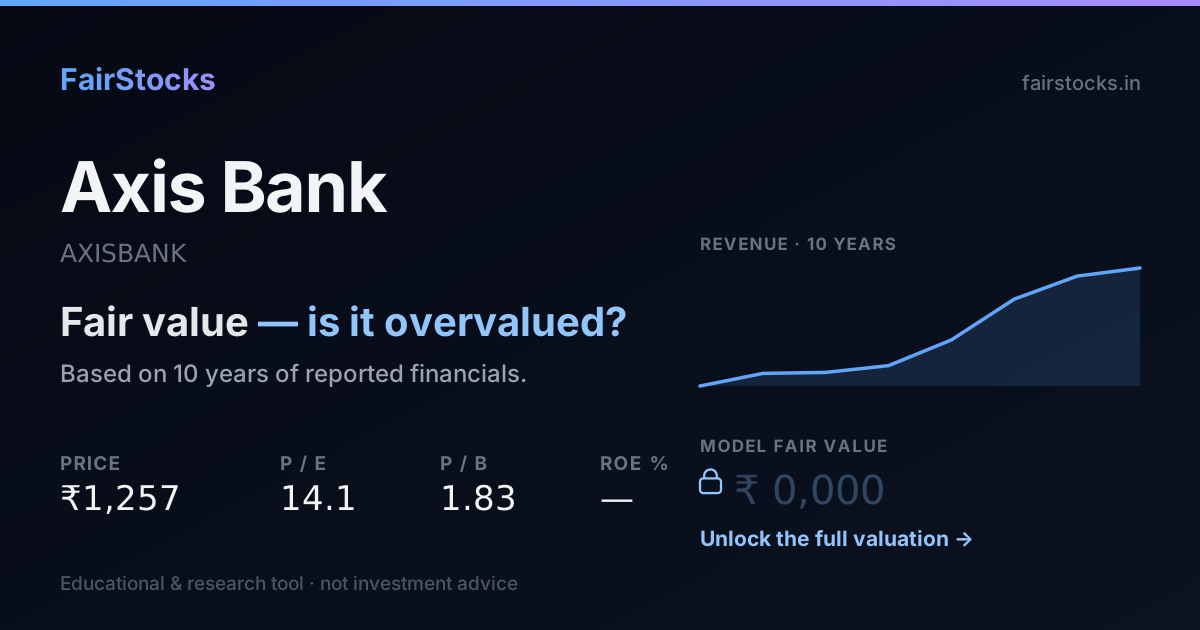
Revenue went from ₹0.70 lakh crore to ₹1.62 lakh crore over the period shown, while return on equity moved from 2.5% to 13.3%. Growing scale on a rising return is a very different proposition from growing scale on a falling one.
How much debt does Axis Bank carry?
Debt to equity stands at 1.32, down from 1.47 at the start of the period — the balance sheet is a core input to the cost of capital used here.
How does FairStocks calculate fair value?
From published financial statements. The method is chosen to fit the business — a bank on excess return, a regulated utility on its rate base, a conglomerate by its parts — and every assumption is shown with its source. When the numbers do not support an estimate, no estimate is published. This is an educational research tool: it reports what the model computed and does not recommend buying or selling anything.
What assumptions are used to value Axis Bank?
A cost of capital of 11.31%, growth drawn from the company's own record rather than from guidance, and the valuation method that fits the business. All of them are listed in the report, with how much each one moves the answer.