On this page ▾
The market expects Bank of Baroda to carry on much as it has.
At today’s share price, buyers are assuming Bank of Baroda earns about 11.4% a year on the money invested in it, from here on. Over the last ten years it actually earned about 13.8% a year. The two are close, so the share price does not need the business to improve or to stumble. It needs it to keep doing roughly what it already does.
- How it is valued: Excess return — the correct lens for a bank.
- What the price assumes: 11.4% return on equity, against 13.8% the model takes from its own record.
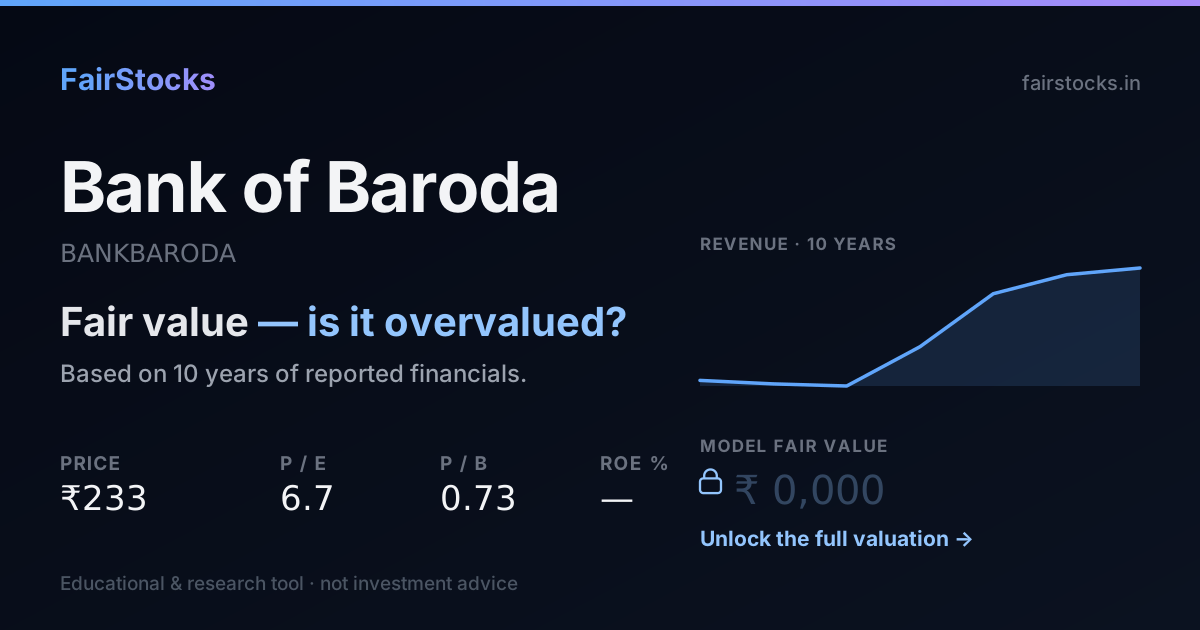
- Ten-year record: Between FY2020 and FY2026, Bank of Baroda's revenue went from ₹91,086 crore to ₹1,56,825 crore — it compounded at about 9% a year over 6 years.
- Biggest swing factor: Return on equity. Main risk: Corporate credit.
01The second-largest public-sector bank
Bank of Baroda, founded in 1908 in Vadodara (then Baroda), is one of India's largest public-sector banks and is majority-owned by the Government of India. It merged with Vijaya Bank and Dena Bank in 2019, and has a larger overseas presence than most Indian banks.
Like other state banks it spent much of the 2010s provisioning for bad corporate loans. Since the clean-up, profits have risen sharply on lower credit costs and steadier retail lending.
02What the market is assuming
Work backwards from today's share price and you can see what buyers are quietly taking for granted. Here is the return on equity that price implies for Bank of Baroda, next to what the model assumes from the company's own record.
The further apart these two numbers are, the bigger the bet a buyer at today's price is making.
03Bank of Baroda's record, in plain numbers
Between FY2020 and FY2026, Bank of Baroda's revenue went from ₹91,086 crore to ₹1,56,825 crore — it compounded at about 9% a year over 6 years. Net profit grew from ₹942 crore to ₹19,477 crore, about 66% a year — faster than revenue, so margins widened. In FY2026 it kept 12.4% of revenue as net profit — against a low of 1.0% in FY2020 and a high of 13.4% in FY2025. The latest year added 2.6% to revenue, well behind its own long-run pace.
Revenue and earnings per share in ₹, return on equity and leverage as ratios — all from the filed statements.
Revenue and net profit by year (₹ crore)
| Year | Revenue | Net profit | Margin |
|---|---|---|---|
| FY2020 | 91,086 | 942 | 1.0% |
| FY2021 | 89,001 | 1,454 | 1.6% |
| FY2022 | 87,780 | 7,700 | 8.8% |
| FY2023 | 1,10,778 | 14,688 | 13.3% |
| FY2024 | 1,41,779 | 18,410 | 13.0% |
| FY2025 | 1,52,884 | 20,459 | 13.4% |
| FY2026 | 1,56,825 | 19,477 | 12.4% |
04How Bank of Baroda gets valued — and why
Excess return — the correct lens for a bankA bank is not valued with a discounted cash flow. Deposits are its raw material and interest is operating income, so enterprise value means nothing here. It is valued on excess return instead — the profit it earns above the cost of the equity funding it.
05What decides Bank of Baroda's value
Return on equity
Whether recent returns hold through a full credit cycle.
Credit costs
Provisions on bad loans swing state-bank profits more than anything.
Deposit costs
Competition for deposits pressures margins.
Retail growth
A larger retail book diversifies away from corporate lending.
06What could go wrong
- Corporate credit. A turn in the corporate cycle would hit provisions first.
- Policy lending. Government priorities can shape lending and pricing.
- Capital. Faster growth needs capital that may dilute holders.
07What the full Bank of Baroda valuation shows
Sign in free to see the complete Bank of Baroda valuation
- ✓Fair value per share — from the excess-return model banks are valued on
- ✓The bank workpaper — book value, cost of equity and sustainable return, step by step
- ✓Bull, base and bear cases — and exactly which assumptions move between them
- ✓Peer comparison — against State Bank of India, ICICI Bank and HDFC Bank
- ✓Downloadable report — the full write-up, yours to keep
08Compare Bank of Baroda with peers
The same valuation, run side by side.
Bank of Baroda vs State Bank of IndiaThe nearest public-sector peer, at larger scale.→Bank of Baroda vs ICICI BankPublic sector against the private-bank benchmark.→Bank of Baroda vs HDFC BankA state bank against the largest private one, same lens.→09Questions people ask about Bank of Baroda
When did Bank of Baroda merge with Vijaya Bank and Dena Bank?
The merger took effect in April 2019, making it one of the largest public-sector banks.
Why do public-sector banks trade at low price-to-book?
Historically lower and more volatile returns on equity, plus government ownership. Price-to-book only means something next to return on equity.
Bank of Baroda or SBI — which is better value?
Both are valued on the same excess-return model; the comparison page sets them side by side.
Is Bank of Baroda overvalued?
At ₹274 the market is pricing in roughly 11.4% sustained ROE, against the ~13.8% its own record supports. That is less than it has delivered — on these numbers the market is asking the business for less than its own record, which usually means it doubts the record repeats.
What is the intrinsic value of Bank of Baroda?
It is computed from the filed financial statements using the method that fits this business (excess return), with every assumption shown alongside the result. The per-share figure and the full working are in the report.
How much debt does Bank of Baroda carry?
Debt to equity stands at 1.03, against 0.85 at the start of the period — the balance sheet is a core input to the cost of capital used here.