On this page ▾
The market expects Sundaram Finance to do better than it ever has.
At today’s share price, buyers are assuming Sundaram Finance earns about 19.7% a year on the money invested in it, from here on. Over the last ten years it actually earned about 15.2% a year. So the share price only makes sense if the business improves on its own track record. If it simply carries on as before, buyers today have paid for something they will not get.
- How it is valued: Excess return — the correct lens for an NBFC.
- What the price assumes: 19.7% return on equity, against 15.2% the model takes from its own record.
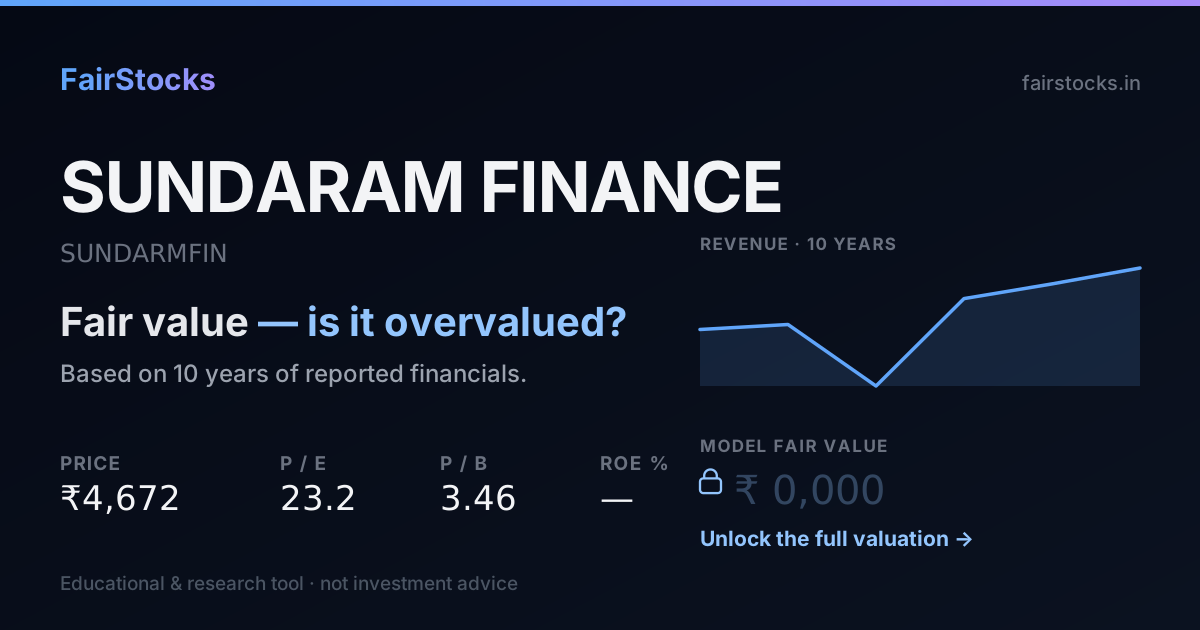
- Ten-year record: Between FY2020 and FY2026, Sundaram Finance's revenue went from ₹4,695 crore to ₹9,809 crore — it compounded at about 13% a year over 6 years.
- Biggest swing factor: Vehicle finance demand. Main risk: Vehicle cycle.
01A Chennai lender since 1954
Sundaram Finance, founded in Chennai in 1954 by T. S. Santhanam and part of the TVS family of companies, finances commercial vehicles, cars, tractors and construction equipment, especially in southern India.
It also owns Sundaram Home Finance and an asset manager, and is known for conservative lending and a long record of low credit losses.
02What the market is assuming
Work backwards from today's share price and you can see what buyers are quietly taking for granted. Here is the return on equity that price implies for Sundaram Finance, next to what the model assumes from the company's own record.
The further apart these two numbers are, the bigger the bet a buyer at today's price is making.
03Sundaram Finance's record, in plain numbers
Between FY2020 and FY2026, Sundaram Finance's revenue went from ₹4,695 crore to ₹9,809 crore — it compounded at about 13% a year over 6 years. In FY2026 it kept 21.0% of revenue as net profit — its weakest year in the period. The latest year added 15.6% to revenue, close to its own long-run pace. FY2021 and FY2023 are missing from the filed series used here, so those years are left out rather than estimated.
Revenue and earnings per share in ₹, return on equity and leverage as ratios — all from the filed statements.
Revenue and net profit by year (₹ crore)
| Year | Revenue | Net profit | Margin |
|---|---|---|---|
| FY2020 | 4,695 | — | — |
| FY2022 | 5,108 | — | — |
| FY2024 | 7,267 | 1,842 | 25.4% |
| FY2025 | 8,486 | 1,879 | 22.1% |
| FY2026 | 9,809 | 2,059 | 21.0% |
04How Sundaram Finance gets valued — and why
Excess return — the correct lens for an NBFCA lender is not valued with a discounted cash flow. Borrowing is the raw material of the business and interest is operating income, so enterprise value means nothing here. It is valued on excess return instead — the profit it earns above the cost of the equity funding it.
05What decides Sundaram Finance's value
Vehicle finance demand
Truck and car sales drive lending.
Credit discipline
Low losses support steady returns.
Subsidiaries
Housing finance and asset management add value.
Funding costs
Borrowing costs affect spreads.
06What could go wrong
- Vehicle cycle. A slowdown cuts lending.
- Competition. Banks offer cheaper vehicle loans.
- Concentration. Heavy exposure to southern India.
07What the full Sundaram Finance valuation shows
Sign in free to see the complete Sundaram Finance valuation
- ✓Fair value per share — from the excess-return model used for lenders
- ✓The lender workpaper — book value, cost of equity and sustainable return, step by step
- ✓Bull, base and bear cases — and exactly which assumptions move between them
- ✓Peer comparison — against Cholamandalam, Shriram Finance and Bajaj Finance
- ✓Downloadable report — the full write-up, yours to keep
08Questions people ask about Sundaram Finance
When was Sundaram Finance founded?
In 1954, in Chennai.
What does Sundaram Finance lend for?
Commercial vehicles, cars, tractors and construction equipment.
Why is Sundaram Finance seen as conservative?
It has a long record of low bad loans and careful growth.
Is Sundaram Finance overvalued?
At ₹4,339 the market is pricing in roughly 19.7% sustained ROE, against the ~15.2% its own record supports. That is more than it has delivered, so the price is justified only if the business can hold a rate it has not previously sustained.
What is the intrinsic value of Sundaram Finance?
It is computed from the filed financial statements using the method that fits this business (excess return), with every assumption shown alongside the result. The per-share figure and the full working are in the report.
How much debt does Sundaram Finance carry?
Debt to equity stands at 2.11, against 1.66 at the start of the period — the balance sheet is a core input to the cost of capital used here.