On this page ▾
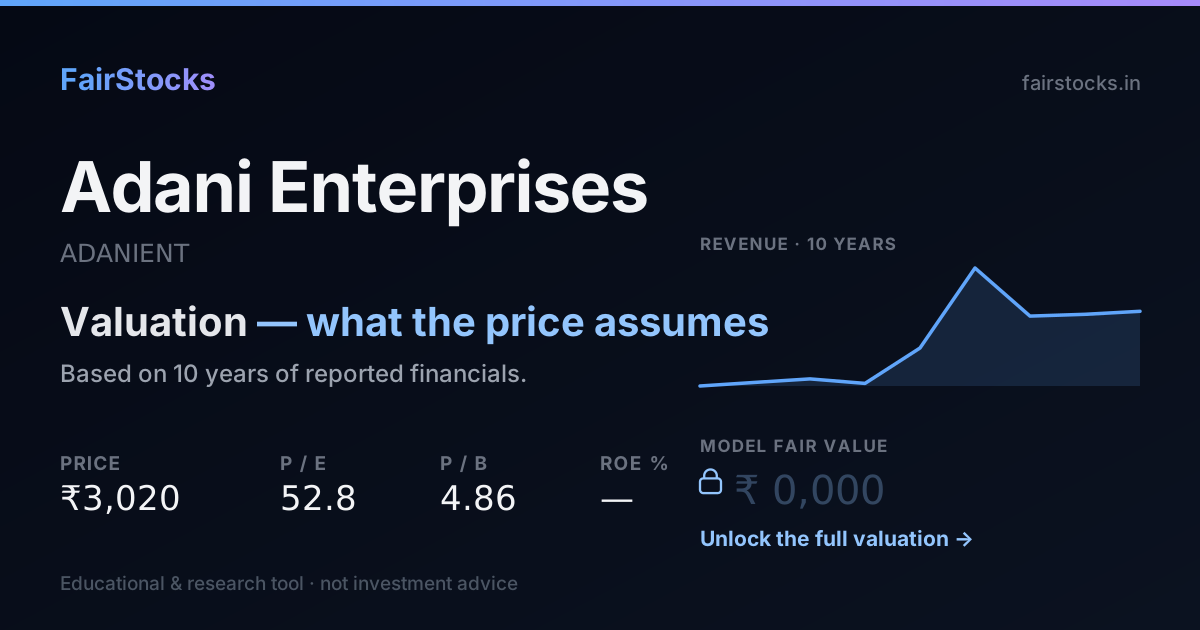
We do not publish one number for Adani Enterprises — and here is why.
Adani Enterprises is really several different businesses under one roof, and they do not work the same way. Adding them together into a single “fair value” would produce a figure that describes none of them. So we value each part on its own terms instead of printing one number that looks tidy and means little.
- How it is valued: business by business, with no single blended figure.
- What the price assumes: 35% growth, against 2% the model takes from its own record.
- Ten-year record: Between FY2018 and FY2026, Adani Enterprises' revenue went from ₹37,382 crore to ₹1,00,469 crore — it compounded at about 13% a year over 8 years.
- Biggest swing factor: Airports. Main risk: Group-level events.
01The Adani group's incubator
Adani Enterprises is the flagship company and incubator of the Adani group. Businesses such as Adani Power, Adani Transmission (now Adani Energy Solutions) and Adani Total Gas began here before being separated and listed on their own. Its largest revenue line is still coal trading, alongside mining services and commercial mining.
The growth businesses are infrastructure. Adani Airport Holdings runs several of India's busiest airports, Adani Road Transport builds and operates highways, Adani New Industries makes solar modules and wind turbines and is building green-hydrogen capacity, and AdaniConneX develops data centres. A copper smelter in Kutch adds a commodity business.
02What the market is assuming
Work backwards from today's share price and you can see what buyers are quietly taking for granted. Here is the growth that price implies for Adani Enterprises, next to what the model assumes from the company's own record.
The further apart these two numbers are, the bigger the bet a buyer at today's price is making.
03Adani Enterprises' record, in plain numbers
Between FY2018 and FY2026, Adani Enterprises' revenue went from ₹37,382 crore to ₹1,00,469 crore — it compounded at about 13% a year over 8 years. Net profit grew from ₹594 crore to ₹9,951 crore, about 42% a year — faster than revenue, so margins widened. In FY2026 it kept 9.9% of revenue as net profit — its best year in the period. The latest year added 2.6% to revenue, well behind its own long-run pace.
Revenue and earnings per share in ₹, return on equity and leverage as ratios — all from the filed statements.
Revenue and net profit by year (₹ crore)
| Year | Revenue | Net profit | Margin |
|---|---|---|---|
| FY2018 | 37,382 | 594 | 1.6% |
| FY2019 | 40,379 | 506 | 1.3% |
| FY2020 | 43,403 | 1,040 | 2.4% |
| FY2021 | 39,537 | 1,046 | 2.6% |
| FY2022 | 69,420 | 788 | 1.1% |
| FY2023 | 1,36,978 | 2,422 | 1.8% |
| FY2024 | 96,421 | 3,335 | 3.5% |
| FY2025 | 97,895 | 8,005 | 8.2% |
| FY2026 | 1,00,469 | 9,951 | 9.9% |
04How Adani Enterprises gets valued — and why
Estimate withheld — the engine says so itselfThis is a group of businesses with different economics. A single discounted cash flow across all of them averages them into something that describes none of them, so our engine withholds a single blended fair value rather than publishing a number it cannot defend. The parts are valued separately instead.
05What decides Adani Enterprises' value
Airports
Passenger growth and non-aeronautical income such as retail and real estate make airports the most valuable of the new businesses.
How the capex is funded
AEL is spending heavily; whether that is paid for with debt, new shares or asset sales changes the value left for each existing share.
New-energy execution
Solar, wind and hydrogen manufacturing have to reach scale and profitability on time.
Coal trading cash flow
The legacy trading business funds the build-out, and its cash flow follows coal prices.
06What could go wrong
- Group-level events. News about the wider Adani group has moved this share price sharply in the past, regardless of how the businesses were performing.
- Leverage. Heavy borrowing to fund new projects raises the cost of capital.
- Long build times. Airports, roads and factories take years to earn back their cost.
07What the full Adani Enterprises valuation shows
Sign in free to see the complete Adani Enterprises valuation
- ✓Segment-by-segment workings — resources, mining, airports, roads, new energy, copper and data centres, each on its own lens
- ✓What each business contributes — and how much of the share price each one explains
- ✓Bull, base and bear cases — and exactly which assumptions move between them
- ✓Peer comparison — against Adani Ports, Reliance Industries and Adani Power
- ✓Downloadable report — the full write-up, yours to keep
08Compare Adani Enterprises with peers
The same valuation, run side by side.
Adani Enterprises vs Adani PortsThe group incubator against its most mature listed business.→Adani Enterprises vs Reliance IndustriesBoth conglomerates, valued by their parts rather than in total.→Adani Enterprises vs Adani PowerAnother group company on very different economics.→09Questions people ask about Adani Enterprises
Why is Adani Enterprises valued by its parts?
Its businesses are at completely different stages — a mature trading arm, airports ramping up, factories still being built. One discounted cash flow would blend them into a growth rate that fits none, so each reported segment is valued separately.
What does Adani Enterprises actually do?
It trades and mines coal, runs airports and roads, makes solar modules and wind turbines, is building green-hydrogen and copper capacity, and develops data centres.
Why is Adani Enterprises' P/E so high?
Because most of its expected value sits in businesses still being built, which earn little today compared with what they are expected to earn. The P/E on current profit misses that, which is why the reverse solve and the segment workings matter more here.
Is Adani Enterprises overvalued?
At ₹2,688 the market is pricing in roughly 35% sustained growth, against the ~2% its own record supports. That is more than it has delivered, so the price is justified only if the business can hold a rate it has not previously sustained.
What is the intrinsic value of Adani Enterprises?
This business is a group of operations with different economics, so a single blended figure would describe none of them. The parts are valued separately and the breakdown is in the report, rather than one number that cannot be defended.
How much debt does Adani Enterprises carry?
Debt to equity stands at 1.17, against 0.99 at the start of the period — the balance sheet is a core input to the cost of capital used here.