If value investing could be reduced to a single idea, this would be it. The margin of safety is what separates investing from speculation — and it is the reason a careful investor can be wrong surprisingly often and still do well over time. This guide explains what it is, how to size it, and why it is not the same thing as buying a low P/E stock.
The idea in one sentence
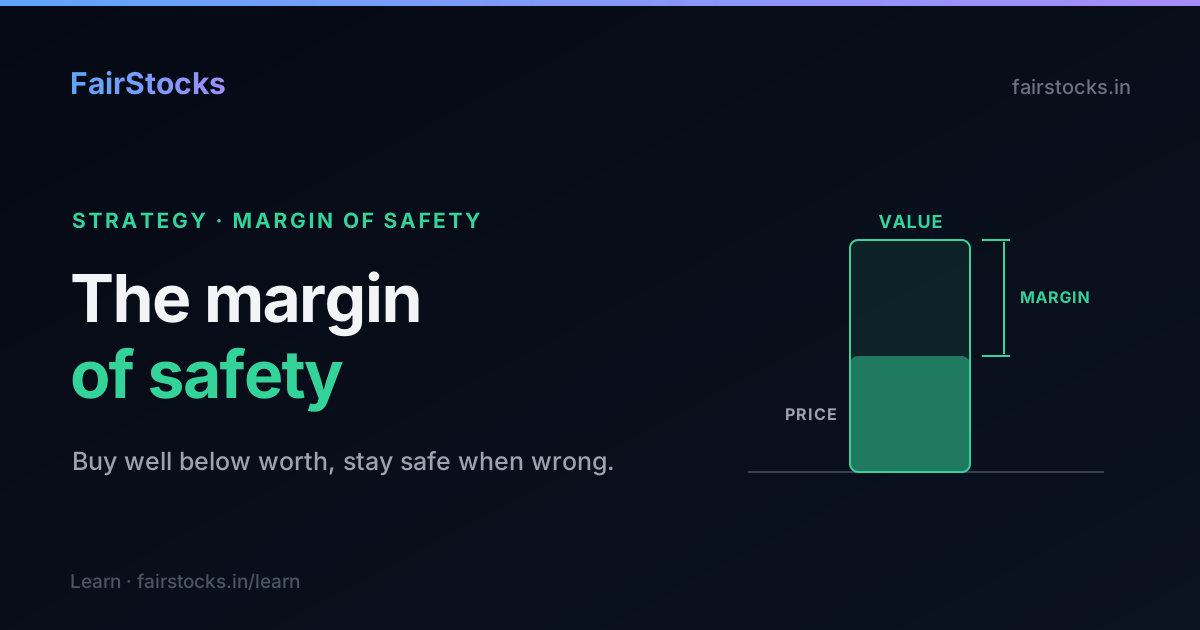
A margin of safety is the gap between what a business is worth and the lower price you pay for it.
Benjamin Graham, who taught the young Warren Buffett, called it the central concept of investment. His illustration was an engineer building a bridge. If the heaviest load the bridge will ever carry is ten tonnes, you do not build it to hold exactly ten tonnes — you build it to hold thirty. That extra capacity is the margin of safety, and it exists precisely because the world does not always behave as expected: an unusually heavy truck, a flaw in the steel, a storm.
Investing is no different. Your valuation is your estimate of the load; the margin of safety is the extra strength you build in so that being wrong does not cause a collapse.
The margin of safety exists because every valuation is a forecast, and forecasts are wrong. It is the buffer that lets you be wrong and still not lose.
Why you need it even after doing the work
It is tempting to think that if you have carefully worked out a stock's intrinsic value, you can simply buy at that value. But a valuation is an estimate, not a measurement. It depends on assumptions — how fast the company grows, what margins it holds, what discount rate is fair — and small changes in those assumptions move the answer a great deal.
So the honest response to an uncertain valuation is not to pretend it is precise. It is to demand a discount large enough that the uncertainty does not hurt you:
- Buy at a large discount to your estimate of value, and if the estimate turns out to be 20% too optimistic, you still have not overpaid.
- Buy at fair value exactly, and the same 20% error means you have overpaid — with nothing to absorb it.
The margin of safety is what turns a fragile decision into a resilient one. It is not a lack of conviction; it is respect for the fact that the future is unknowable.
How big should the margin be?
There is no single number, because the right margin depends on how confident you can be in the valuation. The less certain the business, the wider the margin you should demand.
- Stable, predictable business — a long record, steady margins, low debt — a discount of roughly 20-30% to fair value may be enough.
- Harder to forecast — cyclical, leveraged, or fast-changing — demand 40-50% or more.
- Genuinely unpredictable — if you cannot estimate the value with any confidence at all, the correct margin is not to buy. No discount rescues a valuation you do not believe.
The margin of safety is the price you charge for your own uncertainty. The less sure you are, the more you demand — and sometimes the answer is to walk away.
This is also why quality matters. A business with a durable competitive advantage and high, stable returns on capital is easier to value with confidence, so it can justify a narrower margin. A weak or erratic business needs a wide one, because the range of possible futures is so much broader.
Why it is not the same as a low P/E
A common trap is to treat a low P/E ratio as a margin of safety. It is not.
A low P/E only means a stock is cheap relative to last year's earnings. But those earnings might be about to fall off a cliff, or the low multiple might be entirely deserved — the classic value trap, where a stock looks cheap all the way down.
A margin of safety is measured against intrinsic value — what the business is worth based on the cash it can generate over many years — not against a single year's profit. The two can point in completely opposite directions:
- A stock can have a low P/E and no margin of safety, if the earnings behind that P/E are deteriorating.
- A stock can have a fair-looking P/E and a large margin of safety, if the market has badly underestimated what the business is worth.
The reference point is everything. Price against last year's earnings is a ratio. Price against intrinsic value is a margin of safety.
The margin of safety is the gap that valuation reveals
Everything on FairStocks is built around this one gap. A valuation produces a fair value; the market produces a price; and the difference between the two is where the margin of safety lives — or fails to.
- When the price sits well below fair value, there is a margin of safety, and the size of the gap tells you how much.
- When the price sits at or above fair value, there is no margin — no matter how excellent the company.
A great business bought with no margin of safety can still be a poor investment, because you have left yourself no room to be wrong. An ordinary business bought at a deep enough discount can be a fine one. The discount, not the pedigree, is what protects your capital.
Find the gap for any stock
You cannot demand a margin of safety without an estimate of value to measure it against. FairStocks calculates a fair value for hundreds of listed Indian companies from their filed accounts and shows it right next to the market price, so the discount — or its absence — is visible immediately. There is even a ranked list of the most undervalued stocks, each shown with the full working, so you can see exactly where the widest margins of safety are.
Graham's insight has lasted a century for a reason. You cannot control whether your valuation is right. You can control how much you pay relative to it — and that discount is the one piece of protection that is always in your hands.