On this page ▾
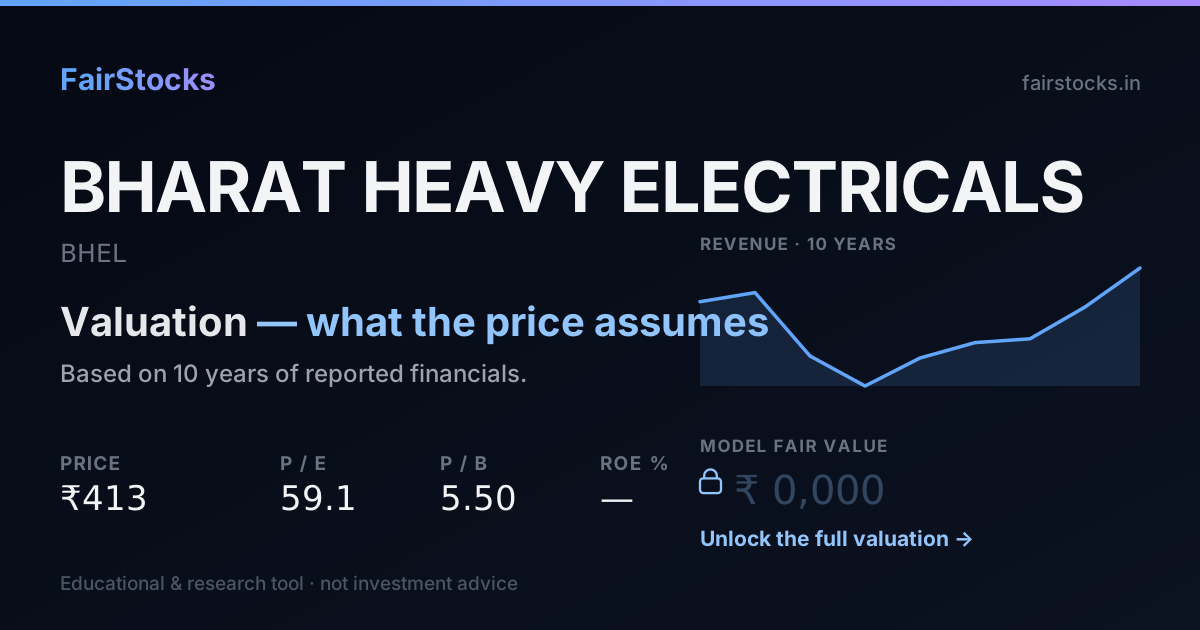
We do not publish one number for BHEL — and here is why.
On today's figures the market pays roughly 20.3 times what our model says BHEL is worth. On a company this widely followed, a gap that large almost always means our model is missing something rather than that thousands of investors are wrong. So we show the workings and say plainly that we cannot stand behind a single figure here.
- How it is valued: no single figure is published here — our model and the market disagree too far.
- What the price assumes: 35% growth, against 14% the model takes from its own record.
- Ten-year record: Between FY2018 and FY2026, BHEL's revenue went from ₹29,075 crore to ₹33,782 crore — it barely moved over 8 years.
- Biggest swing factor: Thermal orders. Main risk: Execution delays.
01India's power-equipment maker
Bharat Heavy Electricals (BHEL), majority-owned by the Government of India, designs and builds boilers, turbines and generators for thermal, hydro and nuclear power stations, as well as equipment for railways, defence and industry.
Thermal orders dried up in the 2010s and BHEL made losses. Since 2023, India's decision to add new coal capacity has brought large orders back.
02What the market is assuming
Work backwards from today's share price and you can see what buyers are quietly taking for granted. Here is the growth that price implies for BHEL, next to what the model assumes from the company's own record.
The further apart these two numbers are, the bigger the bet a buyer at today's price is making.
03BHEL's record, in plain numbers
Between FY2018 and FY2026, BHEL's revenue went from ₹29,075 crore to ₹33,782 crore — it barely moved over 8 years. It reported a net loss in FY2020 and FY2021, and closed the period with net profit of ₹1,600 crore. In FY2026 it kept 4.7% of revenue as net profit — its best year in the period. The latest year added 19.2% to revenue, well ahead of its own long-run pace.
Revenue and earnings per share in ₹, return on equity and leverage as ratios — all from the filed statements.
Revenue and net profit by year (₹ crore)
| Year | Revenue | Net profit | Margin |
|---|---|---|---|
| FY2018 | 29,075 | 438 | 1.5% |
| FY2019 | 30,349 | 1,215 | 4.0% |
| FY2020 | 21,490 | -1,468 | -6.8% |
| FY2021 | 17,309 | -2,700 | -15.6% |
| FY2022 | 21,211 | 445 | 2.1% |
| FY2023 | 23,365 | 477 | 2.0% |
| FY2024 | 23,893 | 282 | 1.2% |
| FY2025 | 28,339 | 534 | 1.9% |
| FY2026 | 33,782 | 1,600 | 4.7% |
04How BHEL gets valued — and why
Estimate withheld — model and market disagree too farOur model and the market disagree so far apart on this company that the model is the more likely one to be wrong. Rather than publish a number we cannot stand behind, we show the workings and say so.
05What decides BHEL's value
Thermal orders
New coal-plant contracts fill the order book.
Execution
Delivering on time converts orders into profit.
Margins
Thin margins must improve for value to follow.
Diversification
Railways and defence add new revenue.
06What could go wrong
- Execution delays. Large projects often slip.
- Working capital. Slow payments tie up cash.
- Coal's future. Fewer coal plants long-term would cut orders.
07What the full BHEL valuation shows
Sign in free to see the complete BHEL valuation
- ✓The full model workings — and exactly where the model and the market part ways
- ✓Every assumption — growth, returns and cost of capital, with sources
- ✓Bull, base and bear cases — and exactly which assumptions move between them
- ✓Peer comparison — against L&T, Siemens and other engineering firms
- ✓Downloadable report — the full write-up, yours to keep
08Questions people ask about BHEL
What does BHEL make?
Boilers, turbines and generators for power plants, plus railway and industrial equipment.
Why did BHEL make losses?
New thermal power orders dried up for years.
Why is BHEL's share price up?
India's new coal-plant programme has brought back large orders.
Is BHEL overvalued?
At ₹436 the market is pricing in roughly 35% sustained growth, against the ~14% its own record supports. That is more than it has delivered, so the price is justified only if the business can hold a rate it has not previously sustained.
What is the intrinsic value of BHEL?
This business is a group of operations with different economics, so a single blended figure would describe none of them. The parts are valued separately and the breakdown is in the report, rather than one number that cannot be defended.