On this page ▾
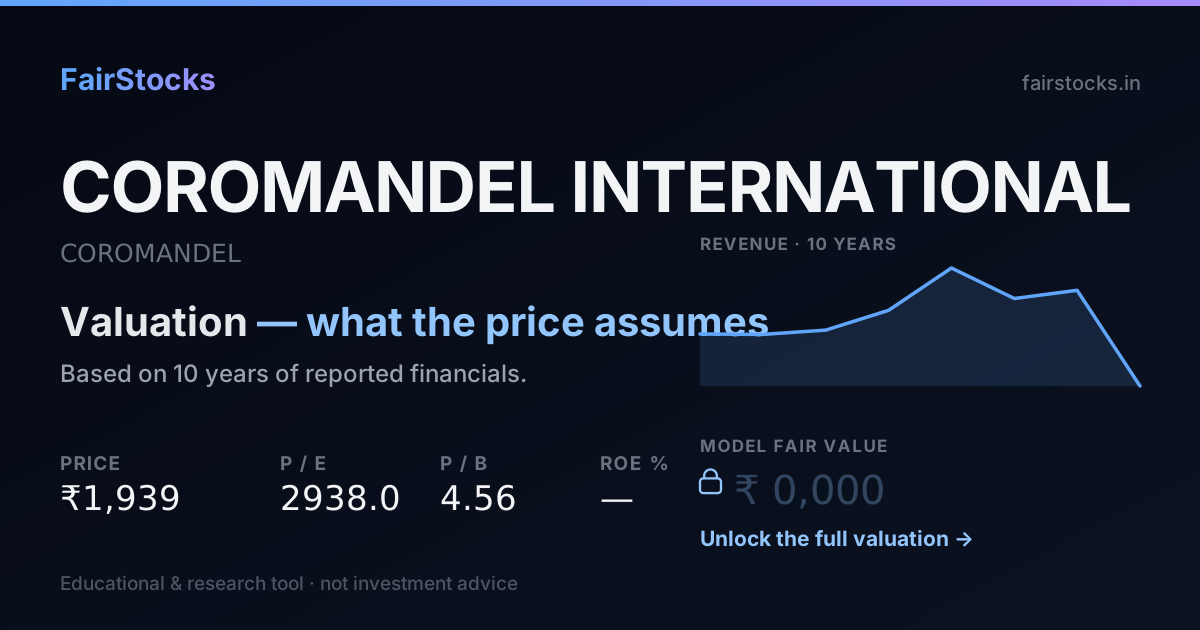
We do not publish one number for Coromandel International — and here is why.
On today's figures the market pays roughly 2.9 times what our model says Coromandel International is worth. On a company this widely followed, a gap that large almost always means our model is missing something rather than that thousands of investors are wrong. So we show the workings and say plainly that we cannot stand behind a single figure here.
- How it is valued: no single figure is published here — our model and the market disagree too far.
- What the price assumes: 29% growth, against 0% the model takes from its own record.
- Ten-year record: Between FY2019 and FY2025, Coromandel International's revenue went from ₹13,225 crore to ₹24,085 crore — it compounded at about 11% a year over 6 years.
- Biggest swing factor: Monsoon. Main risk: Subsidy delays.
01The Murugappa group's farm business
Coromandel International, part of Chennai's Murugappa group, makes phosphatic and complex fertilisers under the Gromor brand, crop-protection chemicals, specialty nutrients and organic products, and runs rural retail stores.
In 2025 it took control of NACL Industries to expand in crop protection. Fertiliser prices are heavily influenced by government subsidies.
02What the market is assuming
Work backwards from today's share price and you can see what buyers are quietly taking for granted. Here is the growth that price implies for Coromandel International, next to what the model assumes from the company's own record.
The further apart these two numbers are, the bigger the bet a buyer at today's price is making.
03Coromandel International's record, in plain numbers
Between FY2019 and FY2025, Coromandel International's revenue went from ₹13,225 crore to ₹24,085 crore — it compounded at about 11% a year over 6 years. Net profit grew from ₹720 crore to ₹2,055 crore, about 19% a year — faster than revenue, so margins widened. In FY2025 it kept 8.5% of revenue as net profit — against a low of 5.4% in FY2019 and a high of 9.4% in FY2021. The latest year added 9.2% to revenue, close to its own long-run pace.
Revenue and earnings per share in ₹, return on equity and leverage as ratios — all from the filed statements.
Revenue and net profit by year (₹ crore)
| Year | Revenue | Net profit | Margin |
|---|---|---|---|
| FY2019 | 13,225 | 720 | 5.4% |
| FY2020 | 13,137 | 1,065 | 8.1% |
| FY2021 | 14,213 | 1,329 | 9.4% |
| FY2022 | 19,111 | 1,528 | 8.0% |
| FY2023 | 29,628 | 2,013 | 6.8% |
| FY2024 | 22,058 | 1,641 | 7.4% |
| FY2025 | 24,085 | 2,055 | 8.5% |
| FY2026 | 315 | 19 | 6.0% |
04How Coromandel International gets valued — and why
Estimate withheld — model and market disagree too farOur model and the market disagree so far apart on this company that the model is the more likely one to be wrong. Rather than publish a number we cannot stand behind, we show the workings and say so.
05What decides Coromandel International's value
Monsoon
Good rains drive fertiliser demand.
Subsidy policy
Government subsidies set effective prices.
Crop protection
Higher-margin chemicals diversify profit.
Raw materials
Phosphoric acid and ammonia costs swing margins.
06What could go wrong
- Subsidy delays. Late payments tie up cash.
- Input price spikes. Imported raw materials can surge.
- Weather. Poor monsoons cut demand.
07What the full Coromandel valuation shows
Sign in free to see the complete Coromandel International valuation
- ✓The full model workings — and exactly where the model and the market part ways
- ✓Every assumption — growth, returns and cost of capital, with sources
- ✓Bull, base and bear cases — and exactly which assumptions move between them
- ✓Peer comparison — against UPL, PI Industries and other agri-input companies
- ✓Downloadable report — the full write-up, yours to keep
08Questions people ask about Coromandel International
What does Coromandel International make?
Phosphatic fertilisers, crop-protection chemicals and specialty nutrients.
How do subsidies affect Coromandel?
Government subsidies set much of the price farmers pay.
Who controls Coromandel?
The Murugappa group.
Is Coromandel International overvalued?
At ₹1,968 the market is pricing in roughly 29% sustained growth, against the ~0% its own record supports. That is more than it has delivered, so the price is justified only if the business can hold a rate it has not previously sustained.
What is the intrinsic value of Coromandel International?
This business is a group of operations with different economics, so a single blended figure would describe none of them. The parts are valued separately and the breakdown is in the report, rather than one number that cannot be defended.
How much debt does Coromandel International carry?
Debt to equity stands at 0.01, against 0.00 at the start of the period — the balance sheet is a core input to the cost of capital used here.