On this page ▾
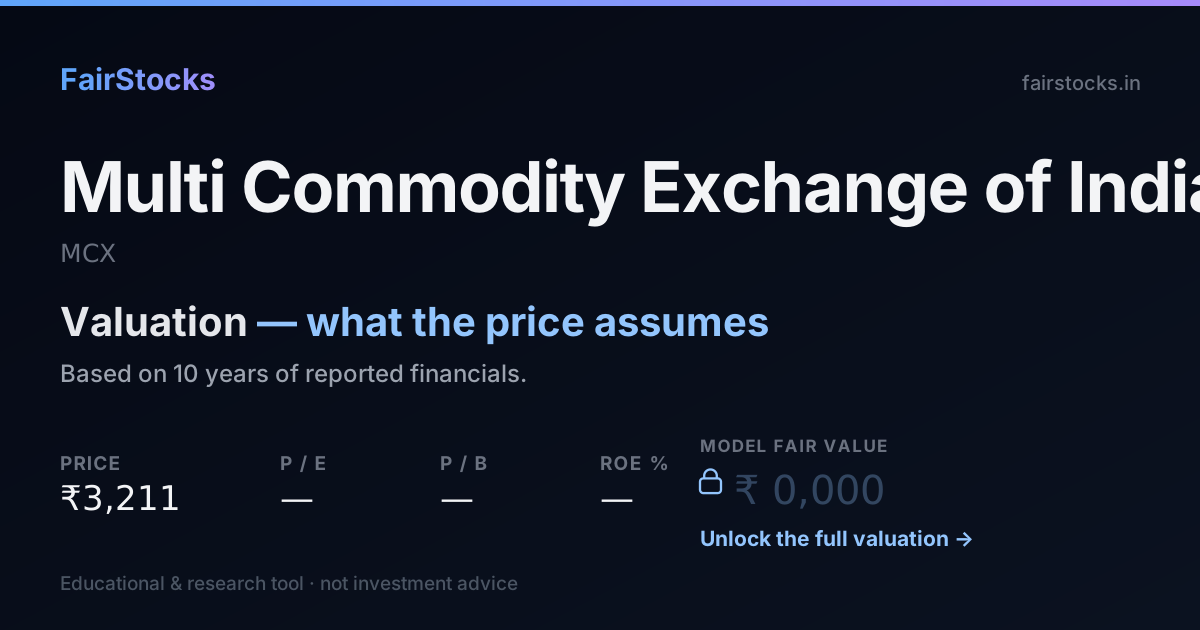
We do not publish one number for MCX — and here is why.
Our engine has not published a single fair value for MCX. Its trading volumes and profits have changed so sharply in a few years — driven by commodity options — that its longer record is a poor guide to the future. The workings are shown instead.
- How it is valued: business by business, with no single blended figure.
- What the price assumes: 13% growth, against 8% the model takes from its own record.
- Biggest swing factor: Options volumes. Main risk: Regulation.
01Where India trades gold and crude
Multi Commodity Exchange of India (MCX), based in Mumbai, is India's largest commodity derivatives exchange, with a dominant share in bullion, energy and base-metal contracts.
After moving to a new trading platform in 2024, and with fast-growing demand for commodity options, its volumes and profits have risen steeply. It earns fees on every contract traded.
02What the market is assuming
Work backwards from today's share price and you can see what buyers are quietly taking for granted. Here is the growth that price implies for MCX, next to what the model assumes from the company's own record.
The further apart these two numbers are, the bigger the bet a buyer at today's price is making.
03MCX's record, in plain numbers
04How MCX gets valued — and why
Estimate withheld — the engine says so itselfThis is a group of businesses with different economics. A single discounted cash flow across all of them averages them into something that describes none of them, so our engine withholds a single blended fair value rather than publishing a number it cannot defend. The parts are valued separately instead.
05What decides MCX's value
Options volumes
Options trading drives most new revenue.
Commodity volatility
Price swings in gold, silver and crude increase trading.
Market share
Near-monopoly in commodity derivatives.
Operating leverage
Costs grow far slower than fees.
06What could go wrong
- Regulation. SEBI rules on derivatives can cut volumes.
- Competition. NSE and BSE could push into commodities.
- Calm markets. Low volatility reduces trading.
07What the full MCX valuation shows
Sign in free to see the complete MCX valuation
- ✓The full model workings — and exactly where the model and the market part ways
- ✓Every assumption — growth, returns and cost of capital, with sources
- ✓Bull, base and bear cases — and exactly which assumptions move between them
- ✓Peer comparison — against BSE and other market-infrastructure companies
- ✓Downloadable report — the full write-up, yours to keep
08Questions people ask about MCX
What does MCX do?
It runs India's main exchange for commodity derivatives such as gold, silver and crude oil.
Why have MCX's profits jumped?
Commodity options trading has grown rapidly.
How does MCX make money?
Fees on each contract traded on its platform.
Is MCX overvalued?
At ₹3,720 the market is pricing in roughly 13% sustained growth, against the ~8% its own record supports. That is more than it has delivered, so the price is justified only if the business can hold a rate it has not previously sustained.
What is the intrinsic value of MCX?
This business is a group of operations with different economics, so a single blended figure would describe none of them. The parts are valued separately and the breakdown is in the report, rather than one number that cannot be defended.