On this page ▾
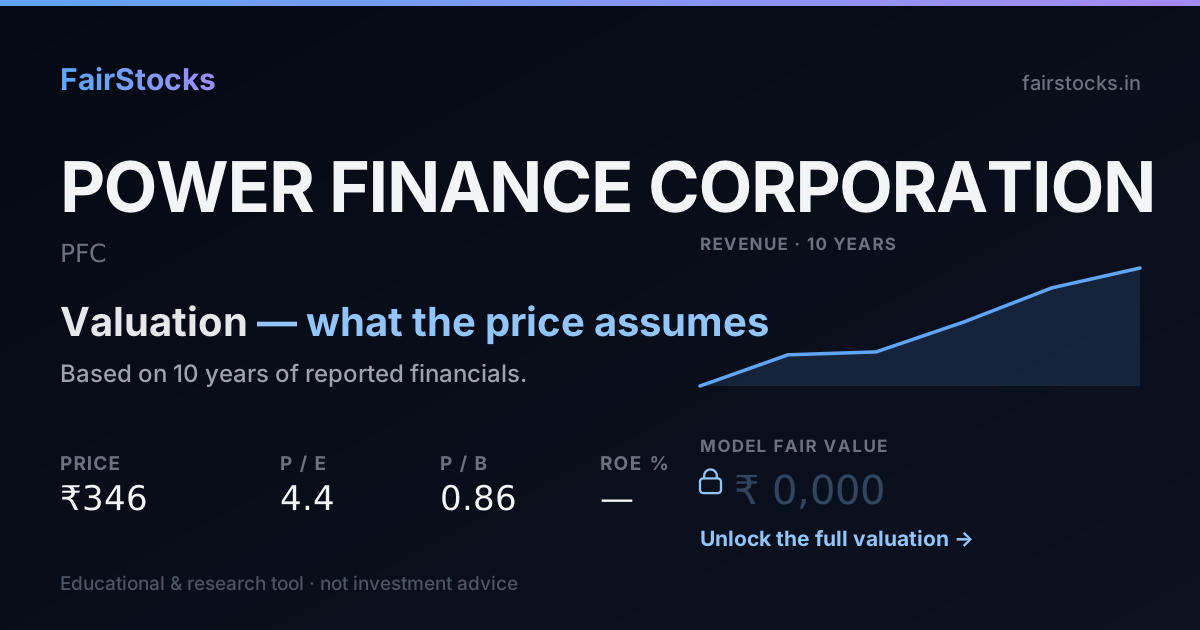
We do not publish one number for Power Finance Corporation — and here is why.
On today's figures our model puts Power Finance Corporation at roughly 14.3 times what the market pays for it. On a company this widely followed, a gap that large almost always means our model is missing something rather than that thousands of investors are wrong. So we show the workings and say plainly that we cannot stand behind a single figure here.
- How it is valued: no single figure is published here — our model and the market disagree too far.
- What the price assumes: 9.4% return on equity, against 25.5% the model takes from its own record.
- Ten-year record: Between FY2020 and FY2026, Power Finance Corporation's revenue went from ₹62,189 crore to ₹1,15,444 crore — it compounded at about 11% a year over 6 years.
- Biggest swing factor: Loan growth. Main risk: Concentration.
01The bank of India's power sector
Power Finance Corporation (PFC) is a state-owned non-bank lender, majority-owned by the Government of India, that finances generation, transmission and distribution projects. Its borrowers are mostly state-owned utilities and large power companies.
In 2019 it bought the government's majority stake in REC, another power-sector lender, so its consolidated accounts include REC. Together they are among the largest lenders in India.
02What the market is assuming
Work backwards from today's share price and you can see what buyers are quietly taking for granted. Here is the return on equity that price implies for Power Finance Corporation, next to what the model assumes from the company's own record.
The further apart these two numbers are, the bigger the bet a buyer at today's price is making.
03Power Finance Corporation's record, in plain numbers
Between FY2020 and FY2026, Power Finance Corporation's revenue went from ₹62,189 crore to ₹1,15,444 crore — it compounded at about 11% a year over 6 years. Net profit grew from ₹9,477 crore to ₹33,625 crore, about 23% a year — faster than revenue, so margins widened. In FY2026 it kept 29.1% of revenue as net profit — its best year in the period. The latest year added 8.4% to revenue, close to its own long-run pace. FY2021 is missing from the filed series used here, so that year is left out rather than estimated.
Revenue and earnings per share in ₹, return on equity and leverage as ratios — all from the filed statements.
Revenue and net profit by year (₹ crore)
| Year | Revenue | Net profit | Margin |
|---|---|---|---|
| FY2020 | 62,189 | 9,477 | 15.2% |
| FY2022 | 76,262 | 18,768 | 24.6% |
| FY2023 | 77,568 | 21,179 | 27.3% |
| FY2024 | 91,097 | 26,461 | 29.0% |
| FY2025 | 1,06,502 | 30,514 | 28.7% |
| FY2026 | 1,15,444 | 33,625 | 29.1% |
04How Power Finance Corporation gets valued — and why
Estimate withheld — model and market disagree too farOur model and the market disagree so far apart on this company that the model is the more likely one to be wrong. Rather than publish a number we cannot stand behind, we show the workings and say so.
05What decides Power Finance Corporation's value
Loan growth
Investment in power and renewables drives demand for loans.
Spreads
Low funding costs from its state backing support margins.
Asset quality
Recoveries from stressed private power projects add to profit.
Dividends
PFC pays a high share of profit as dividends.
06What could go wrong
- Concentration. Heavy exposure to one sector and to state utilities.
- State discom finances. Weak distributors can delay repayment.
- Policy. Government direction can shape lending.
07What the full PFC valuation shows
Sign in free to see the complete Power Finance Corporation valuation
- ✓The full model workings — and exactly where the model and the market part ways
- ✓Every assumption — growth, returns and cost of capital, with sources
- ✓Bull, base and bear cases — and exactly which assumptions move between them
- ✓Peer comparison — against Power Grid, NTPC and Bajaj Finance
- ✓Downloadable report — the full write-up, yours to keep
08Compare Power Finance Corporation with peers
The same valuation, run side by side.
Power Finance Corporation vs Power GridThe power-sector financier against the grid it lends to build.→Power Finance Corporation vs NTPCFinancing generation against owning it.→Power Finance Corporation vs Bajaj FinanceA policy-driven infrastructure lender against a consumer NBFC.→09Questions people ask about Power Finance Corporation
What does PFC do?
It lends to power-generation, transmission and distribution projects across India.
What is PFC's relationship with REC?
PFC bought a majority stake in REC in 2019, so REC is its subsidiary.
PFC or Power Grid — which is better value?
The lender against the grid it helps finance, compared side by side on their own page.
Is Power Finance Corporation overvalued?
At ₹334 the market is pricing in roughly 9.4% sustained ROE, against the ~25.5% its own record supports. That is less than it has delivered — on these numbers the market is asking the business for less than its own record, which usually means it doubts the record repeats.
What is the intrinsic value of Power Finance Corporation?
This business is a group of operations with different economics, so a single blended figure would describe none of them. The parts are valued separately and the breakdown is in the report, rather than one number that cannot be defended.
How much debt does Power Finance Corporation carry?
Debt to equity stands at 2.72, down from 2.92 at the start of the period — the balance sheet is a core input to the cost of capital used here.