On this page ▾
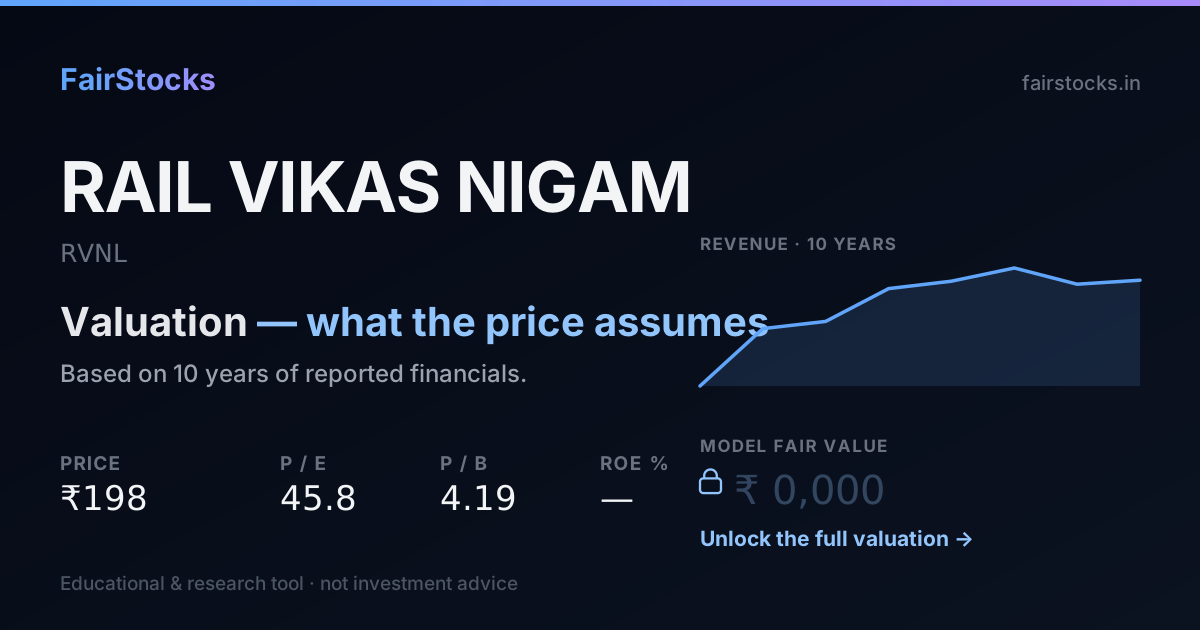
We do not publish one number for RVNL — and here is why.
On today's figures the market pays roughly 6.5 times what our model says RVNL is worth. On a company this widely followed, a gap that large almost always means our model is missing something rather than that thousands of investors are wrong. So we show the workings and say plainly that we cannot stand behind a single figure here.
- How it is valued: no single figure is published here — our model and the market disagree too far.
- What the price assumes: 35% growth, against 3% the model takes from its own record.
- Ten-year record: Between FY2019 and FY2026, RVNL's revenue went from ₹7,557 crore to ₹20,412 crore — it compounded at about 15% a year over 7 years.
- Biggest swing factor: Railway capex. Main risk: Thin margins.
01The railways' project builder
Rail Vikas Nigam (RVNL), set up in 2003 and majority-owned by the Government of India, executes rail infrastructure projects: new lines, gauge conversion, doubling, electrification, workshops and metro systems.
Most of its work comes from the Ministry of Railways on a cost-plus basis, and it has begun bidding competitively for projects in India and abroad.
02What the market is assuming
Work backwards from today's share price and you can see what buyers are quietly taking for granted. Here is the growth that price implies for RVNL, next to what the model assumes from the company's own record.
The further apart these two numbers are, the bigger the bet a buyer at today's price is making.
03RVNL's record, in plain numbers
Between FY2019 and FY2026, RVNL's revenue went from ₹7,557 crore to ₹20,412 crore — it compounded at about 15% a year over 7 years. Net profit grew from ₹470 crore to ₹871 crore, about 9% a year — slower than revenue, so margins narrowed. In FY2026 it kept 4.3% of revenue as net profit — its weakest year in the period. The latest year added 2.5% to revenue, well behind its own long-run pace.
Revenue and earnings per share in ₹, return on equity and leverage as ratios — all from the filed statements.
Revenue and net profit by year (₹ crore)
| Year | Revenue | Net profit | Margin |
|---|---|---|---|
| FY2019 | 7,557 | 470 | 6.2% |
| FY2020 | 14,531 | 753 | 5.2% |
| FY2021 | 15,404 | 922 | 6.0% |
| FY2022 | 19,382 | 1,183 | 6.1% |
| FY2023 | 20,282 | 1,421 | 7.0% |
| FY2024 | 21,889 | 1,574 | 7.2% |
| FY2025 | 19,923 | 1,282 | 6.4% |
| FY2026 | 20,412 | 871 | 4.3% |
04How RVNL gets valued — and why
Estimate withheld — model and market disagree too farOur model and the market disagree so far apart on this company that the model is the more likely one to be wrong. Rather than publish a number we cannot stand behind, we show the workings and say so.
05What decides RVNL's value
Railway capex
Government spending drives orders.
Competitive bids
New contracts outside nominated work.
Execution
Turning orders into revenue.
Margins
Thin construction margins limit profit.
06What could go wrong
- Thin margins. Small cost overruns hurt profit.
- Policy shifts. Changes in how railways award work.
- The premium. The price assumes large growth.
07What the full RVNL valuation shows
Sign in free to see the complete RVNL valuation
- ✓The full model workings — and exactly where the model and the market part ways
- ✓Every assumption — growth, returns and cost of capital, with sources
- ✓Bull, base and bear cases — and exactly which assumptions move between them
- ✓Peer comparison — against IRFC, L&T and other infrastructure companies
- ✓Downloadable report — the full write-up, yours to keep
08Questions people ask about RVNL
What does RVNL do?
Builds rail infrastructure — new lines, doubling, electrification and metros.
Who owns RVNL?
The Government of India holds the majority.
Why are RVNL's margins thin?
It is a construction contractor, often working on a cost-plus basis.
Is RVNL overvalued?
At ₹199 the market is pricing in roughly 35% sustained growth, against the ~3% its own record supports. That is more than it has delivered, so the price is justified only if the business can hold a rate it has not previously sustained.
What is the intrinsic value of RVNL?
This business is a group of operations with different economics, so a single blended figure would describe none of them. The parts are valued separately and the breakdown is in the report, rather than one number that cannot be defended.
How much debt does RVNL carry?
Debt to equity stands at 0.56, down from 1.15 at the start of the period — the balance sheet is a core input to the cost of capital used here.