On this page ▾
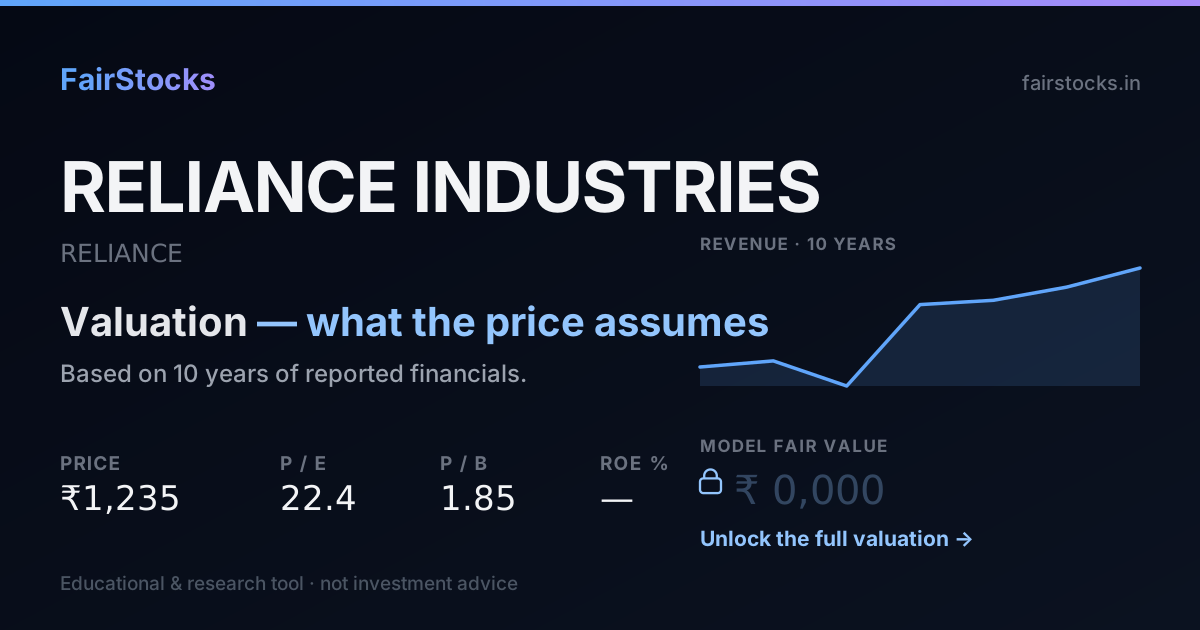
We do not publish one number for Reliance Industries — and here is why.
Reliance Industries is really several different businesses under one roof, and they do not work the same way. Adding them together into a single “fair value” would produce a figure that describes none of them. So we value each part on its own terms instead of printing one number that looks tidy and means little.
- How it is valued: business by business, with no single blended figure.
- What the price assumes: 6% growth, against 7% the model takes from its own record.
- Ten-year record: Between FY2019 and FY2026, Reliance Industries' revenue went from ₹5,81,020 crore to ₹10,75,675 crore — it compounded at about 9% a year over 7 years.
- Biggest swing factor: Jio's revenue per user. Main risk: The holding-company discount.
01Three businesses under one share price
Reliance Industries started out in textiles and petrochemicals and is now India's most valuable listed company. Its oldest engine, oil-to-chemicals (O2C), runs the Jamnagar refining complex and turns crude oil into fuels, polymers and polyester. Profits there rise and fall with global refining margins, which is why the segment is valued as a capital-heavy commodity business.
The two newer engines behave nothing like a refinery. Jio, launched in 2016, became India's largest mobile operator by subscribers and now also sells home broadband and enterprise connectivity. Reliance Retail runs grocery, fashion, electronics and online commerce across thousands of stores. Add the KG-D6 gas fields, the JioStar media venture and a new-energy build-out at Jamnagar, and you have a group whose parts grow at different speeds and deserve different multiples.
02What the market is assuming
Work backwards from today's share price and you can see what buyers are quietly taking for granted. Here is the growth that price implies for Reliance Industries, next to what the model assumes from the company's own record.
The further apart these two numbers are, the bigger the bet a buyer at today's price is making.
03Reliance Industries' record, in plain numbers
Between FY2019 and FY2026, Reliance Industries' revenue went from ₹5,81,020 crore to ₹10,75,675 crore — it compounded at about 9% a year over 7 years. Net profit grew from ₹39,837 crore to ₹95,754 crore, about 13% a year — faster than revenue, so margins widened. In FY2026 it kept 8.9% of revenue as net profit — against a low of 6.5% in FY2020 and a high of 11.0% in FY2021. The latest year added 9.7% to revenue, close to its own long-run pace. FY2022 is missing from the filed series used here, so that year is left out rather than estimated.
Revenue and earnings per share in ₹, return on equity and leverage as ratios — all from the filed statements.
Revenue and net profit by year (₹ crore)
| Year | Revenue | Net profit | Margin |
|---|---|---|---|
| FY2019 | 5,81,020 | 39,837 | 6.9% |
| FY2020 | 6,11,645 | 39,880 | 6.5% |
| FY2021 | 4,86,326 | 53,739 | 11.0% |
| FY2023 | 8,92,944 | 74,088 | 8.3% |
| FY2024 | 9,14,472 | 79,020 | 8.6% |
| FY2025 | 9,80,136 | 81,309 | 8.3% |
| FY2026 | 10,75,675 | 95,754 | 8.9% |
04How Reliance Industries gets valued — and why
Estimate withheld — the engine says so itselfThis is a group of businesses with different economics. A single discounted cash flow across all of them averages them into something that describes none of them, so our engine withholds a single blended fair value rather than publishing a number it cannot defend. The parts are valued separately instead.
05What decides Reliance Industries' value
Jio's revenue per user
The network is already built, so each tariff increase drops almost straight to profit. How far revenue per user can rise without losing subscribers is the biggest single swing factor in the group's value.
Retail's store economics
Retail is worth what each store earns once it matures, not how many stores open. Slower same-store growth would shrink this part of the valuation faster than any other.
Refining margins
O2C is still the largest segment by revenue. A few dollars a barrel on refining margins moves group earnings by thousands of crores.
Return on the capex
Reliance has spent heavily on 5G, retail and new energy. Whether that capital earns more than it costs decides whether the spending created value or diluted it.
06What could go wrong
- The holding-company discount. Markets often value conglomerates below the sum of their parts, and that discount can last for years.
- New energy is still a bet. The solar, battery and hydrogen projects are early, capital-hungry and not yet proven at scale.
- A telecom price war. Aggressive pricing in mobile would undo the tariff gains that underpin Jio's value.
07What the full Reliance valuation shows
Sign in free to see the complete Reliance Industries valuation
- ✓Segment-by-segment workings — O2C, Oil & Gas, Retail and Jio, each valued on the lens that fits it
- ✓What each business contributes — so you can see where Reliance's value actually sits
- ✓Bull, base and bear cases — and exactly which assumptions move between them
- ✓Peer comparison — against IOC, BPCL, ONGC and Bharti Airtel on the same measures
- ✓Downloadable report — the full write-up, yours to keep
08Compare Reliance Industries with peers
The same valuation, run side by side.
Reliance Industries vs ONGCBoth oil & gas, opposite bets: ONGC is upstream production, Reliance is refining plus consumer.→Reliance Industries vs Indian OilThe closest refining comparison — similar throughput, without the telecom and retail arms.→Reliance Industries vs BPCLRefining and marketing head to head, on the same cost of capital.→Reliance Industries vs Bharti AirtelJio against Airtel — the same subscriber war, but one of them also refines oil.→Reliance Industries vs Adani EnterprisesBoth conglomerates the model has to value by their parts rather than as a single business.→09Questions people ask about Reliance Industries
Why is Reliance valued business by business?
A single discounted cash flow would average a refinery, a telecom network and a retail chain into one growth rate that fits none of them. The engine values each reported segment on its own terms instead, which is the honest way to value a conglomerate.
Which Reliance business is worth the most?
That depends on the assumptions for each segment — exactly what the segment workings lay out. The full valuation shows the value the model puts on O2C, Jio, Retail and Oil & Gas, and how much of the share price each one explains.
Does the refining business still matter to Reliance?
Yes. O2C remains the largest segment by revenue and a major source of cash, even as Jio and Retail grow faster. Swings in global refining margins still show up quickly in group profit.
Is Reliance Industries overvalued?
At ₹1,340 the market is pricing in roughly 6% sustained growth, against the ~7% its own record supports. That is close to what it has delivered, so the price is broadly consistent with the company simply continuing as it has.
What is the intrinsic value of Reliance Industries?
This business is a group of operations with different economics, so a single blended figure would describe none of them. The parts are valued separately and the breakdown is in the report, rather than one number that cannot be defended.
How much debt does Reliance Industries carry?
Debt to equity stands at 0.30, against 0.22 at the start of the period — the balance sheet is a core input to the cost of capital used here.