On this page ▾
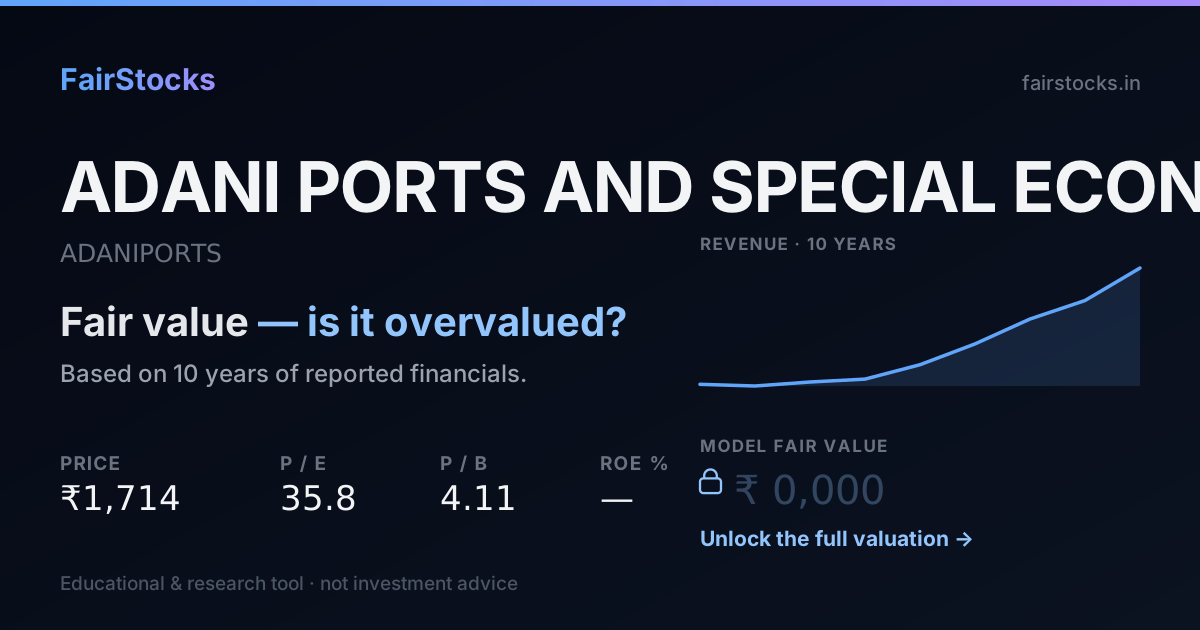
The market expects Adani Ports to carry on much as it has.
At today’s share price, buyers are assuming Adani Ports grows about 24% a year, forever. Over the last ten years it actually grew about 25% a year. The two are close, so the share price does not need the business to improve or to stumble. It needs it to keep doing roughly what it already does.
- How it is valued: Discounted cash flow.
- What the price assumes: 24% growth, against 25% the model takes from its own record.
- Ten-year record: Between FY2018 and FY2026, Adani Ports' revenue went from ₹11,323 crore to ₹38,736 crore — it compounded at about 17% a year over 8 years.
- Biggest swing factor: Cargo volumes. Main risk: Group-level events.
01Ports, logistics and an economic zone
Adani Ports and Special Economic Zone (APSEZ) is India's largest private port operator. Mundra in Gujarat is its flagship, and it runs ports and terminals along both coasts and overseas — including Haifa in Israel and a terminal in Colombo. It also owns the special economic zone at Mundra, with land for industry.
Ports are long-life infrastructure: once a berth is built, extra cargo adds revenue at little extra cost, which is why APSEZ's margins are among the highest of any Indian infrastructure company. It is now adding rail, warehousing, trucking and marine services to capture more of each shipment's journey.
02What the market is assuming
Work backwards from today's share price and you can see what buyers are quietly taking for granted. Here is the growth that price implies for Adani Ports, next to what the model assumes from the company's own record.
The further apart these two numbers are, the bigger the bet a buyer at today's price is making.
03Adani Ports' record, in plain numbers
Between FY2018 and FY2026, Adani Ports' revenue went from ₹11,323 crore to ₹38,736 crore — it compounded at about 17% a year over 8 years. Net profit grew from ₹3,690 crore to ₹12,782 crore, about 17% a year — roughly in step with revenue. In FY2026 it kept 33.0% of revenue as net profit — against a low of 25.9% in FY2023 and a high of 40.2% in FY2021. The latest year added 24.6% to revenue, well ahead of its own long-run pace.
Revenue and earnings per share in ₹, return on equity and leverage as ratios — all from the filed statements.
Revenue and net profit by year (₹ crore)
| Year | Revenue | Net profit | Margin |
|---|---|---|---|
| FY2018 | 11,323 | 3,690 | 32.6% |
| FY2019 | 10,925 | 4,045 | 37.0% |
| FY2020 | 11,873 | 3,785 | 31.9% |
| FY2021 | 12,550 | 5,049 | 40.2% |
| FY2022 | 15,934 | 4,795 | 30.1% |
| FY2023 | 20,852 | 5,393 | 25.9% |
| FY2024 | 26,711 | 8,104 | 30.3% |
| FY2025 | 31,079 | 11,061 | 35.6% |
| FY2026 | 38,736 | 12,782 | 33.0% |
04How Adani Ports gets valued — and why
Discounted cash flowThis business is valued on the cash it is expected to generate, discounted back at its cost of capital — with growth taken from its own ten-year record rather than from guidance.
05What decides Adani Ports' value
Cargo volumes
Volume growth above India's trade growth — from new ports, new berths and market share — is the core of the valuation.
Acquisitions
Bought ports add cargo immediately but only add value if the price paid earns more than the cost of capital.
Logistics margins
Logistics grows revenue fast but at lower margins than ports, so the mix matters.
Capex returns
New terminals and capacity need to fill up quickly to earn back their cost.
06What could go wrong
- Group-level events. News about the wider Adani group can move the share price and funding costs even when the ports are unaffected.
- Global trade and geopolitics. A trade slowdown, or conflict near overseas assets such as Haifa, would hit volumes.
- Overpaying for growth. An aggressive acquisition at a high price would dilute returns.
07What the full Adani Ports valuation shows
Sign in free to see the complete Adani Ports valuation
- ✓Fair value per share — from a ten-year discounted cash flow, every step shown
- ✓The Workbench — change revenue growth, the discount rate or terminal growth and watch Adani Ports' value move
- ✓Bull, base and bear cases — and exactly which assumptions move between them
- ✓Peer comparison — against Adani Enterprises and Larsen & Toubro
- ✓Downloadable report — the full write-up, yours to keep
08Compare Adani Ports with peers
The same valuation, run side by side.
Adani Ports vs Adani EnterprisesThe group parent, valued by its parts.→Adani Ports vs Larsen & ToubroOperating infrastructure against building it.→Adani Ports vs Container CorporationInland logistics against port infrastructure.Adani Ports vs JSW InfrastructureThe nearest listed private port comparison.09Questions people ask about Adani Ports
Why are Adani Ports' margins so high?
Ports have high fixed costs and low running costs. Once a berth is built, each extra container adds revenue at little extra cost — so margins rise as utilisation does.
Does Adani group news affect Adani Ports?
It has in the past. Even when the port business is unaffected, group-level events can move the share price and borrowing costs. The valuation works from APSEZ's own filed cash flows.
How do acquisitions affect Adani Ports' valuation?
Acquired ports add cargo immediately but are often bought at full prices. Value is created only if the return on the price paid beats the cost of capital — the test the DCF applies.
Is Adani Ports overvalued?
At ₹1,903 the market is pricing in roughly 24% sustained growth, against the ~25% its own record supports. That is close to what it has delivered, so the price is broadly consistent with the company simply continuing as it has.
What is the intrinsic value of Adani Ports?
It is computed from the filed financial statements using the method that fits this business (discounted cash flow), with every assumption shown alongside the result. The per-share figure and the full working are in the report.
How much debt does Adani Ports carry?
Debt to equity stands at 0.53, down from 1.03 at the start of the period — the balance sheet is a core input to the cost of capital used here.