On this page ▾
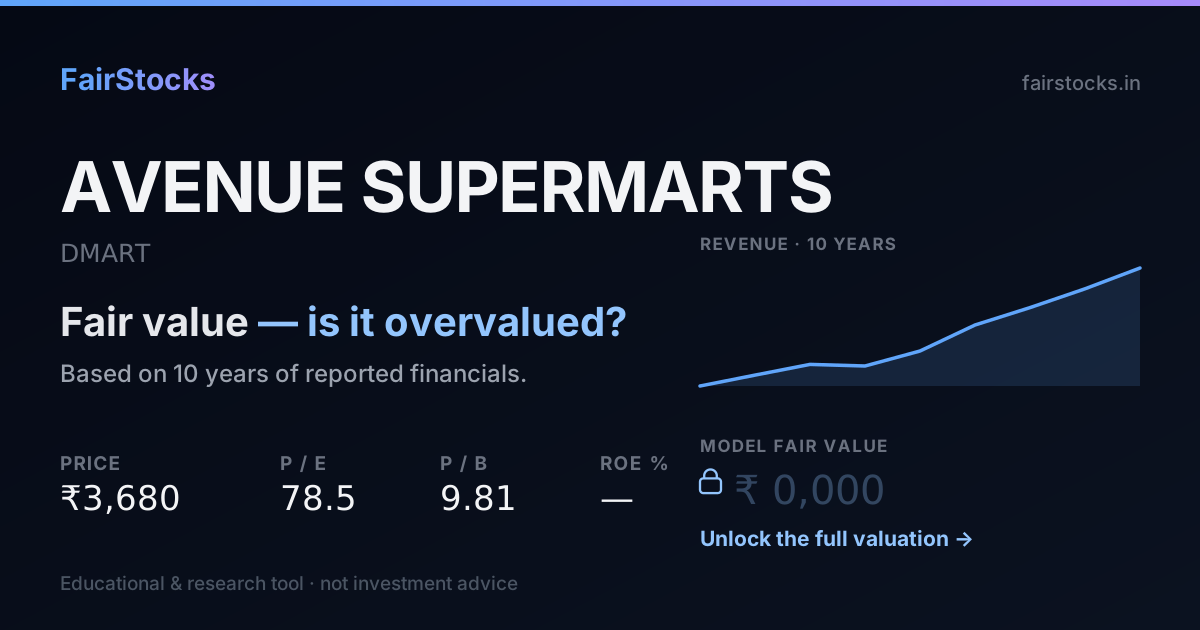
The market expects DMart to do better than it ever has.
At today’s share price, buyers are assuming DMart grows about 32% a year, forever. Over the last ten years it actually grew about 19% a year. So the share price only makes sense if the business improves on its own track record. If it simply carries on as before, buyers today have paid for something they will not get.
- How it is valued: Discounted cash flow.
- What the price assumes: 32% growth, against 19% the model takes from its own record.
- Ten-year record: Between FY2018 and FY2026, DMart's revenue went from ₹15,033 crore to ₹68,821 crore — it compounded at about 21% a year over 8 years.
- Biggest swing factor: Store openings. Main risk: Quick-commerce competition.
01Everyday low prices, owned stores
DMart is run by Avenue Supermarts, founded by Radhakishan Damani, which opened its first store in Mumbai in 2002. It sells groceries, household goods and basic apparel at everyday low prices, and also runs DMart Ready for online orders.
Its model is built on low costs: it usually owns its stores rather than renting them, keeps a narrow product range, turns over inventory quickly and pays suppliers fast in return for better prices. Margins are thin, but returns on capital are steady.
02What the market is assuming
Work backwards from today's share price and you can see what buyers are quietly taking for granted. Here is the growth that price implies for DMart, next to what the model assumes from the company's own record.
The further apart these two numbers are, the bigger the bet a buyer at today's price is making.
03DMart's record, in plain numbers
Between FY2018 and FY2026, DMart's revenue went from ₹15,033 crore to ₹68,821 crore — it compounded at about 21% a year over 8 years. Net profit grew from ₹806 crore to ₹2,970 crore, about 18% a year — slower than revenue, so margins narrowed. Net margin has been unusually stable, between 4.3% and 5.6% in every year shown. The latest year added 15.9% to revenue, well behind its own long-run pace.
Revenue and earnings per share in ₹, return on equity and leverage as ratios — all from the filed statements.
Revenue and net profit by year (₹ crore)
| Year | Revenue | Net profit | Margin |
|---|---|---|---|
| FY2018 | 15,033 | 806 | 5.4% |
| FY2019 | 20,005 | 902 | 4.5% |
| FY2020 | 24,870 | 1,301 | 5.2% |
| FY2021 | 24,143 | 1,099 | 4.6% |
| FY2022 | 30,976 | 1,492 | 4.8% |
| FY2023 | 42,840 | 2,378 | 5.6% |
| FY2024 | 50,789 | 2,536 | 5.0% |
| FY2025 | 59,358 | 2,707 | 4.6% |
| FY2026 | 68,821 | 2,970 | 4.3% |
04How DMart gets valued — and why
Discounted cash flowThis business is valued on the cash it is expected to generate, discounted back at its cost of capital — with growth taken from its own ten-year record rather than from guidance.
05What decides DMart's value
Store openings
New stores are the main source of growth, and each costs a lot because DMart usually owns the property.
Same-store growth
Sales growth in existing stores shows whether the model still works as competition rises.
Quick commerce
Ten-minute delivery apps are changing how urban India buys groceries.
Margins
With net margins this thin, small changes in costs move profit a lot.
06What could go wrong
- Quick-commerce competition. Fast delivery apps are taking some urban grocery spending.
- Slower store expansion. Finding and buying suitable sites takes time.
- The multiple. A high valuation assumes growth keeps compounding.
07What the full DMart valuation shows
Sign in free to see the complete DMart valuation
- ✓Fair value per share — from a ten-year discounted cash flow, every step shown
- ✓The Workbench — change revenue growth, the discount rate or terminal growth and watch DMart's value move
- ✓Bull, base and bear cases — and exactly which assumptions move between them
- ✓Peer comparison — against Trent, Titan and Hindustan Unilever
- ✓Downloadable report — the full write-up, yours to keep
08Compare DMart with peers
The same valuation, run side by side.
DMart vs TrentEveryday-value grocery against fashion retail, both store-network stories.→DMart vs Titan CompanyGroceries bought weekly against jewellery bought once a decade.→DMart vs Hindustan UnileverThe shelf against the brands that sit on it.→09Questions people ask about DMart
Why does DMart own its stores?
Owning avoids rising rents and lets it keep prices low for years, at the cost of slower, more capital-heavy expansion.
Is quick commerce a threat to DMart?
It competes for some urban grocery spending; DMart's answer is lower prices and DMart Ready. The scenarios test what slower same-store growth would mean.
DMart or Trent — which is better value?
Two store-network retailers, compared side by side on their own page.
Is DMart overvalued?
At ₹3,439 the market is pricing in roughly 32% sustained growth, against the ~19% its own record supports. That is more than it has delivered, so the price is justified only if the business can hold a rate it has not previously sustained.
What is the intrinsic value of DMart?
It is computed from the filed financial statements using the method that fits this business (discounted cash flow), with every assumption shown alongside the result. The per-share figure and the full working are in the report.
How much debt does DMart carry?
Debt to equity stands at 0.05, against 0.03 at the start of the period — the balance sheet is a core input to the cost of capital used here.