On this page ▾
The market expects much less from Bharti Airtel than it has delivered before.
At today’s share price, buyers are assuming Bharti Airtel grows about 9% a year, forever. Over the last ten years it actually grew about 16% a year. That is a big step down from its own record. Either the market can see a problem that the published accounts do not show yet, or it is expecting a slowdown that has not happened.
- How it is valued: Discounted cash flow.
- What the price assumes: 9% growth, against 16% the model takes from its own record.
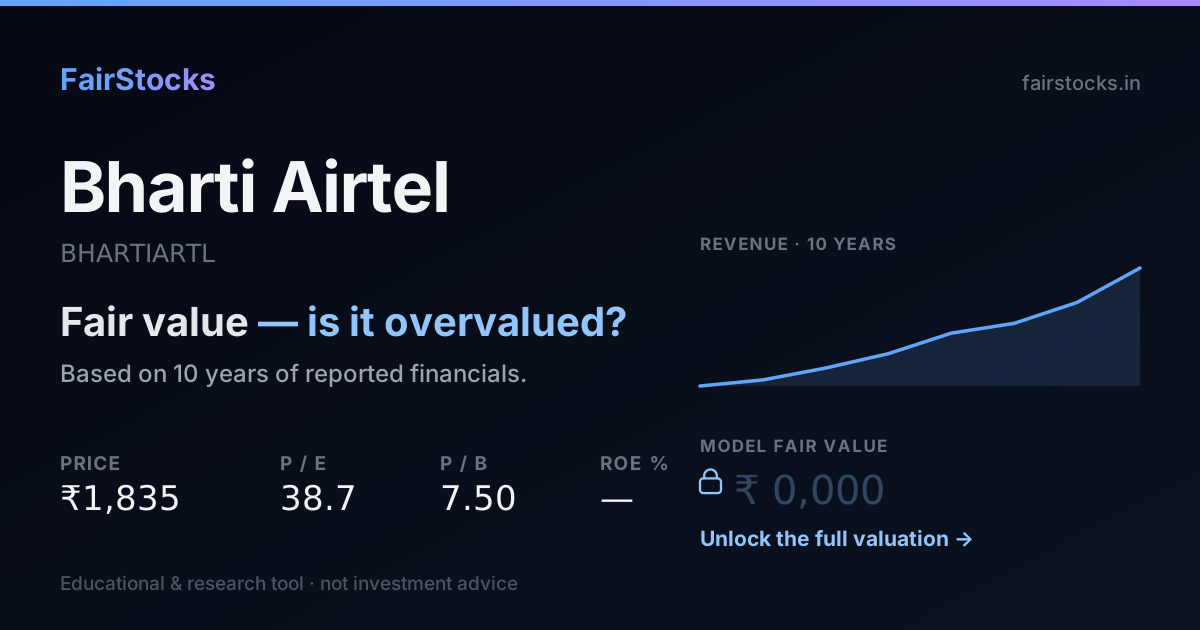
- Ten-year record: Between FY2019 and FY2026, Bharti Airtel's revenue went from ₹80,780 crore to ₹2,10,973 crore — it compounded at about 15% a year over 7 years.
- Biggest swing factor: Average revenue per user. Main risk: Government levies.
01What Airtel does — and why its profits jumped
Bharti Airtel is India's second-largest mobile operator. It also runs home broadband, a DTH television service, and Airtel Business, which sells connectivity and cloud services to companies. It consolidates Indus Towers, the tower company, and controls Airtel Africa, which operates in more than a dozen African countries and is listed in London.
Telecom is a fixed-cost business. Spectrum and networks are paid for up front; once they are in place, each extra rupee of revenue per user is mostly profit. That is why Airtel's earnings rose so sharply once the industry shrank to three private operators and tariffs started to climb.
02What the market is assuming
Work backwards from today's share price and you can see what buyers are quietly taking for granted. Here is the growth that price implies for Bharti Airtel, next to what the model assumes from the company's own record.
The further apart these two numbers are, the bigger the bet a buyer at today's price is making.
03Bharti Airtel's record, in plain numbers
Between FY2019 and FY2026, Bharti Airtel's revenue went from ₹80,780 crore to ₹2,10,973 crore — it compounded at about 15% a year over 7 years. It reported a net loss in FY2020 and FY2021, and closed the period with net profit of ₹33,823 crore. In FY2026 it kept 16.0% of revenue as net profit — against a low of -35.0% in FY2020 and a high of 21.7% in FY2025. The latest year added 22.0% to revenue, well ahead of its own long-run pace.
Revenue and earnings per share in ₹, return on equity and leverage as ratios — all from the filed statements.
Revenue and net profit by year (₹ crore)
| Year | Revenue | Net profit | Margin |
|---|---|---|---|
| FY2019 | 80,780 | 1,688 | 2.1% |
| FY2020 | 87,539 | -30,664 | -35.0% |
| FY2021 | 1,00,616 | -12,364 | -12.3% |
| FY2022 | 1,16,547 | 8,305 | 7.1% |
| FY2023 | 1,39,145 | 12,287 | 8.8% |
| FY2024 | 1,49,982 | 8,558 | 5.7% |
| FY2025 | 1,72,985 | 37,481 | 21.7% |
| FY2026 | 2,10,973 | 33,823 | 16.0% |
04How Bharti Airtel gets valued — and why
Discounted cash flowThis business is valued on the cash it is expected to generate, discounted back at its cost of capital — with growth taken from its own ten-year record rather than from guidance.
05What decides Bharti Airtel's value
Average revenue per user
ARPU is the number the whole valuation turns on. Airtel has led the industry on it, and further tariff increases flow almost directly into cash flow.
Capex after 5G
With 5G largely rolled out, capex as a share of revenue should fall. How fast it falls decides how much free cash flow shareholders actually see.
Africa and currency
Airtel Africa grows quickly in local currency, but devaluations in markets such as Nigeria can erase those gains once converted into rupees.
Spectrum dues and leases
Deferred spectrum payments and lease liabilities sit on the balance sheet and feed straight into the cost of capital.
06What could go wrong
- Government levies. The AGR ruling showed how quickly regulatory dues can swing reported profit. Licence fees and spectrum charges remain a live risk.
- Renewed price competition. A price war would reverse the tariff gains the current valuation leans on.
- New kinds of competitor. Satellite broadband and enterprise-focused rivals could pressure parts of the business over time.
07What the full Bharti Airtel valuation shows
Sign in free to see the complete Bharti Airtel valuation
- ✓Fair value per share — from a ten-year discounted cash flow, every step shown
- ✓The Workbench — change revenue growth, the discount rate or terminal growth and watch Airtel's value move
- ✓Bull, base and bear cases — and exactly which assumptions move between them
- ✓Peer comparison — against Reliance (Jio), Vodafone Idea and Tata Communications
- ✓Downloadable report — the full write-up, yours to keep
08Compare Bharti Airtel with peers
The same valuation, run side by side.
Bharti Airtel vs Reliance IndustriesJio versus Airtel, though Reliance carries refining and retail alongside it.→Bharti Airtel vs Vodafone IdeaThe third operator, on very different balance-sheet footing.→Bharti Airtel vs Tata CommunicationsEnterprise connectivity rather than consumer mobile.→Bharti Airtel vs Larsen & ToubroBoth carry enormous fixed-asset bases where the return on new capex decides the value.→09Questions people ask about Bharti Airtel
Why is Bharti Airtel's P/E so high?
Because earnings are still catching up with a network that has already been paid for. Telecom profits lag the investment by years, so a high P/E on today's earnings can sit alongside a reasonable price on future cash flow. The valuation tests which reading the numbers support.
Does Airtel Africa affect Bharti Airtel's valuation?
Yes. Airtel Africa is consolidated into Bharti's accounts, so both its growth and its currency losses flow into group results and into the cash flows the model uses.
How does 5G change Airtel's value?
5G was the last big round of network spending. If capex now falls as a share of revenue while tariffs rise, free cash flow expands quickly; if the network needs more spending than expected, that cash is pushed out. The scenarios in the full valuation test exactly that trade-off.
Is Bharti Airtel overvalued?
At ₹2,106 the market is pricing in roughly 9% sustained growth, against the ~16% its own record supports. That is less than it has delivered — on these numbers the market is asking the business for less than its own record, which usually means it doubts the record repeats.
What is the intrinsic value of Bharti Airtel?
It is computed from the filed financial statements using the method that fits this business (discounted cash flow), with every assumption shown alongside the result. The per-share figure and the full working are in the report.
How much debt does Bharti Airtel carry?
Debt to equity stands at 1.65, down from 2.03 at the start of the period — the balance sheet is a core input to the cost of capital used here.