On this page ▾
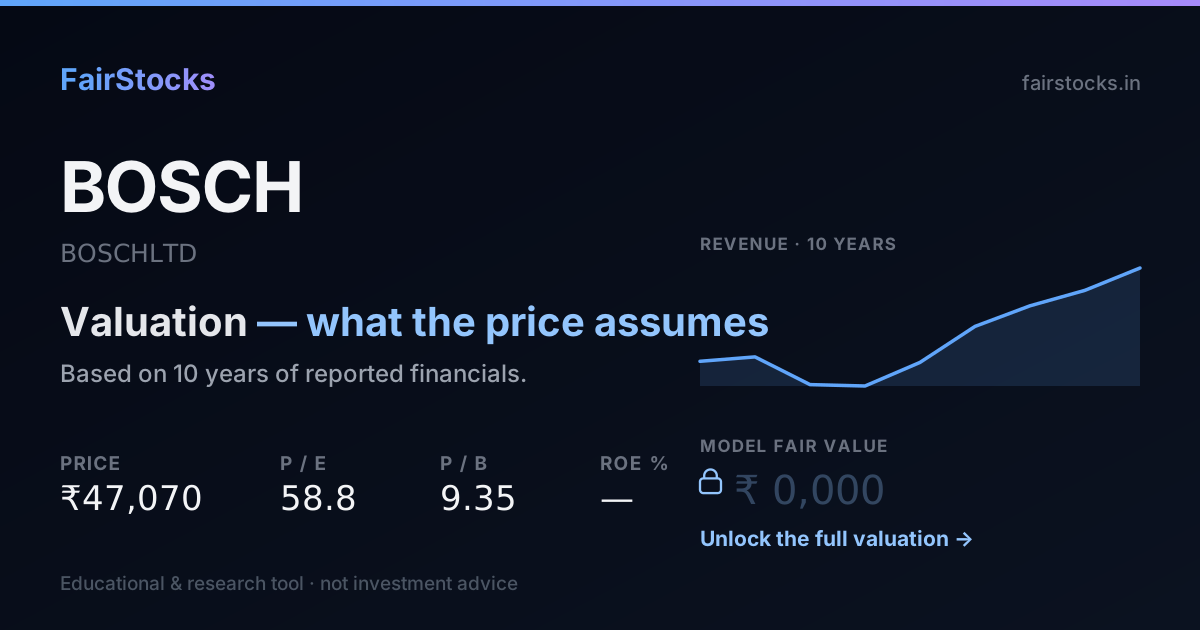
The market expects Bosch India to do better than it ever has.
At today’s share price, buyers are assuming Bosch India grows about 35% a year, forever. Over the last ten years it actually grew about 12% a year. So the share price only makes sense if the business improves on its own track record. If it simply carries on as before, buyers today have paid for something they will not get.
- How it is valued: Discounted cash flow.
- What the price assumes: 35% growth, against 12% the model takes from its own record.
- Ten-year record: Between FY2018 and FY2026, Bosch India's revenue went from ₹11,872 crore to ₹20,035 crore — it compounded at about 7% a year over 8 years.
- Biggest swing factor: Vehicle production. Main risk: Electrification.
01A German engineering name in India since 1922
Bosch Ltd, majority-owned by Germany's Robert Bosch, has operated in India for over a century. Its biggest business is mobility: diesel and petrol fuel-injection systems, sensors, brakes and aftermarket parts for cars, trucks, tractors and two-wheelers.
It also sells power tools, security systems and building technology. Large cash balances and investments sit on its balance sheet.
02What the market is assuming
Work backwards from today's share price and you can see what buyers are quietly taking for granted. Here is the growth that price implies for Bosch India, next to what the model assumes from the company's own record.
The further apart these two numbers are, the bigger the bet a buyer at today's price is making.
03Bosch India's record, in plain numbers
Between FY2018 and FY2026, Bosch India's revenue went from ₹11,872 crore to ₹20,035 crore — it compounded at about 7% a year over 8 years. Net profit grew from ₹1,371 crore to ₹2,773 crore, about 9% a year — faster than revenue, so margins widened. In FY2026 it kept 13.8% of revenue as net profit — against a low of 5.0% in FY2021 and a high of 14.9% in FY2024. The latest year added 10.8% to revenue, well ahead of its own long-run pace.
Revenue and earnings per share in ₹, return on equity and leverage as ratios — all from the filed statements.
Revenue and net profit by year (₹ crore)
| Year | Revenue | Net profit | Margin |
|---|---|---|---|
| FY2018 | 11,872 | 1,371 | 11.5% |
| FY2019 | 12,258 | 1,598 | 13.0% |
| FY2020 | 9,842 | 650 | 6.6% |
| FY2021 | 9,716 | 482 | 5.0% |
| FY2022 | 11,782 | 1,218 | 10.3% |
| FY2023 | 14,929 | 1,426 | 9.5% |
| FY2024 | 16,727 | 2,491 | 14.9% |
| FY2025 | 18,087 | 2,015 | 11.1% |
| FY2026 | 20,035 | 2,773 | 13.8% |
04How Bosch India gets valued — and why
Discounted cash flowThis business is valued on the cash it is expected to generate, discounted back at its cost of capital — with growth taken from its own ten-year record rather than from guidance.
05What decides Bosch India's value
Vehicle production
Its sales follow car, truck and tractor output.
Emission rules
Tighter norms raise content per vehicle.
EV transition
Electric vehicles need fewer engine parts.
Aftermarket
Replacement parts give steady, high-margin revenue.
06What could go wrong
- Electrification. Fewer combustion engines reduce demand for its core products.
- Auto cycles. Vehicle downturns hit sales.
- Parent pricing. Royalties and related-party pricing affect margins.
07What the full Bosch India valuation shows
Sign in free to see the complete Bosch India valuation
- ✓The full model workings — and exactly where the model and the market part ways
- ✓Every assumption — growth, returns and cost of capital, with sources
- ✓Bull, base and bear cases — and exactly which assumptions move between them
- ✓Peer comparison — against Motherson and other auto-parts makers
- ✓Downloadable report — the full write-up, yours to keep
08Questions people ask about Bosch India
Who owns Bosch India?
Germany's Robert Bosch holds the majority of Bosch Ltd.
What does Bosch India make?
Fuel-injection systems, auto parts, power tools and security systems.
How do electric vehicles affect Bosch India?
They need fewer engine parts, so Bosch must grow other products.
Is Bosch India overvalued?
At ₹49,390 the market is pricing in roughly 35% sustained growth, against the ~12% its own record supports. That is more than it has delivered, so the price is justified only if the business can hold a rate it has not previously sustained.
What is the intrinsic value of Bosch India?
It is computed from the filed financial statements using the method that fits this business (discounted cash flow), with every assumption shown alongside the result. The per-share figure and the full working are in the report.
How much debt does Bosch India carry?
Debt to equity stands at 0.00, against 0.00 at the start of the period — the balance sheet is a core input to the cost of capital used here.