On this page ▾
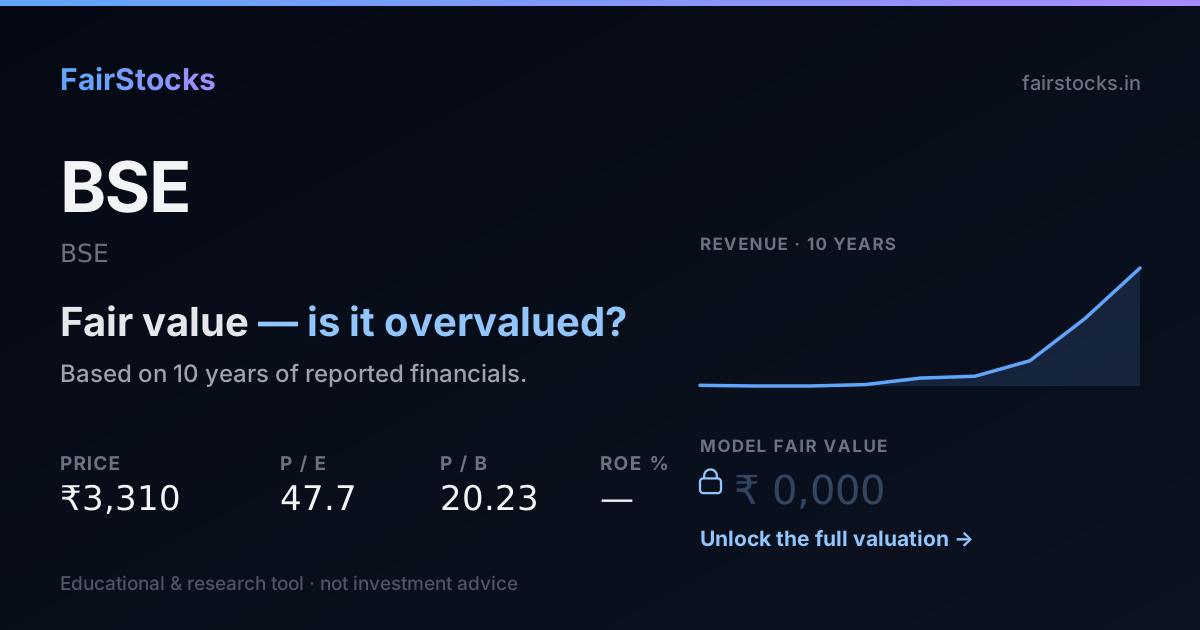
The market expects BSE to carry on much as it has.
At today’s share price, buyers are assuming BSE grows about 35% a year, forever. Over the last ten years it actually grew about 35% a year. The two are close, so the share price does not need the business to improve or to stumble. It needs it to keep doing roughly what it already does.
- How it is valued: Discounted cash flow.
- What the price assumes: 35% growth, against 35% the model takes from its own record.
- Ten-year record: Between FY2019 and FY2026, BSE's revenue went from ₹450 crore to ₹4,834 crore — it compounded at about 40% a year over 7 years.
- Biggest swing factor: Options volumes. Main risk: Regulatory curbs.
01The Bombay Stock Exchange
BSE, founded in 1875 as the Native Share & Stock Brokers' Association, is Asia's oldest stock exchange. It runs equity, derivatives, currency and mutual-fund trading platforms and earns fees on transactions, listings and data.
After relaunching Sensex options with a different weekly expiry day, its share of India's options trading jumped, transforming its revenue and profit.
02What the market is assuming
Work backwards from today's share price and you can see what buyers are quietly taking for granted. Here is the growth that price implies for BSE, next to what the model assumes from the company's own record.
The further apart these two numbers are, the bigger the bet a buyer at today's price is making.
03BSE's record, in plain numbers
Between FY2019 and FY2026, BSE's revenue went from ₹450 crore to ₹4,834 crore — it compounded at about 40% a year over 7 years. Net profit grew from ₹199 crore to ₹2,487 crore, about 43% a year — faster than revenue, so margins widened. In FY2026 it kept 51.5% of revenue as net profit — against a low of 25.2% in FY2023 and a high of 55.5% in FY2024. The latest year added 63.5% to revenue, well ahead of its own long-run pace.
Revenue and earnings per share in ₹, return on equity and leverage as ratios — all from the filed statements.
Revenue and net profit by year (₹ crore)
| Year | Revenue | Net profit | Margin |
|---|---|---|---|
| FY2018 | 477 | 725 | 151.9% |
| FY2019 | 450 | 199 | 44.3% |
| FY2020 | 451 | 121 | 26.8% |
| FY2021 | 501 | 142 | 28.3% |
| FY2022 | 743 | 245 | 33.0% |
| FY2023 | 816 | 206 | 25.2% |
| FY2024 | 1,390 | 772 | 55.5% |
| FY2025 | 2,957 | 1,322 | 44.7% |
| FY2026 | 4,834 | 2,487 | 51.5% |
04How BSE gets valued — and why
Discounted cash flowThis business is valued on the cash it is expected to generate, discounted back at its cost of capital — with growth taken from its own ten-year record rather than from guidance.
05What decides BSE's value
Options volumes
Derivatives trading drives most new revenue.
Market share
Competing with NSE for traders.
Regulation
SEBI rules on retail options trading directly affect volumes.
Operating leverage
Costs grow slowly, so margins rise with volume.
06What could go wrong
- Regulatory curbs. Tighter derivatives rules can cut volumes sharply.
- Competition. NSE dominates and can respond.
- Market downturns. Lower activity reduces fees.
07What the full BSE valuation shows
Sign in free to see the complete BSE valuation
- ✓Fair value per share — from a ten-year discounted cash flow, every step shown
- ✓The Workbench — change revenue growth, the discount rate or terminal growth and watch BSE's value move
- ✓Bull, base and bear cases — and exactly which assumptions move between them
- ✓Peer comparison — against MCX and other market-infrastructure companies
- ✓Downloadable report — the full write-up, yours to keep
08Questions people ask about BSE
Why has BSE's profit grown so fast?
Its Sensex options contracts took a large share of India's derivatives trading.
How does SEBI regulation affect BSE?
Rules on options trading change volumes and therefore fees.
Is BSE the oldest stock exchange in Asia?
Yes; it was founded in 1875.
Is BSE overvalued?
At ₹3,938 the market is pricing in roughly 35% sustained growth, against the ~35% its own record supports. That is close to what it has delivered, so the price is broadly consistent with the company simply continuing as it has.
What is the intrinsic value of BSE?
It is computed from the filed financial statements using the method that fits this business (discounted cash flow), with every assumption shown alongside the result. The per-share figure and the full working are in the report.
How much debt does BSE carry?
Debt to equity stands at 0.00, against 0.00 at the start of the period — the balance sheet is a core input to the cost of capital used here.