On this page ▾
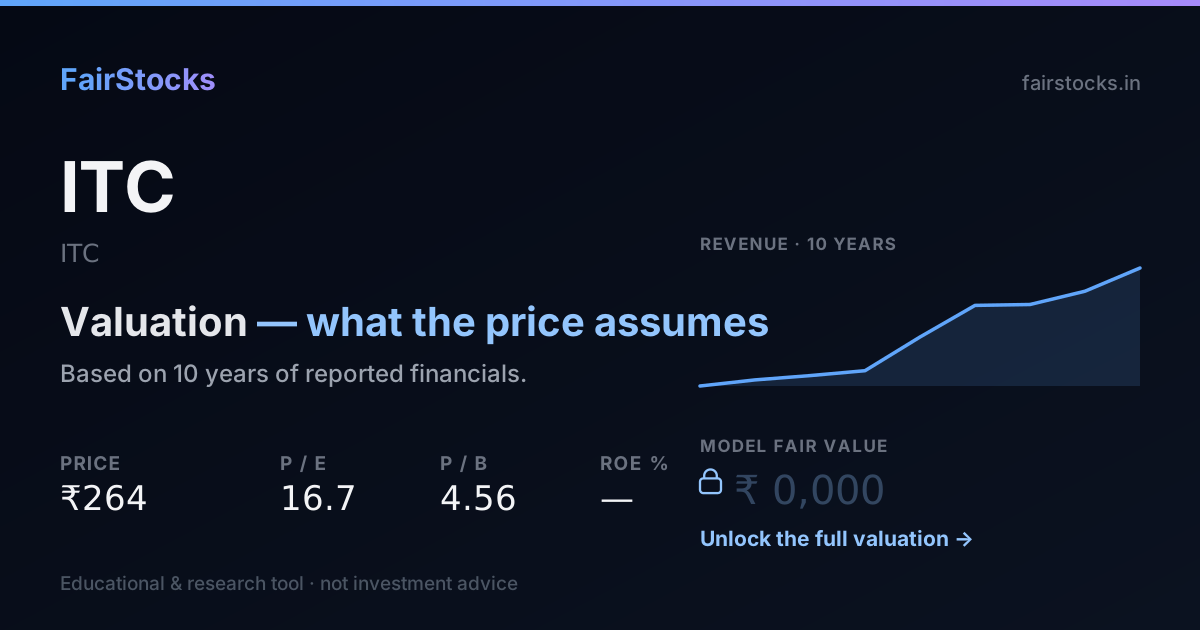
We do not publish one number for ITC — and here is why.
ITC is really several different businesses under one roof, and they do not work the same way. Adding them together into a single “fair value” would produce a figure that describes none of them. So we value each part on its own terms instead of printing one number that looks tidy and means little.
- How it is valued: business by business, with no single blended figure.
- What the price assumes: 0% growth, against 8% the model takes from its own record.
- Ten-year record: Between FY2018 and FY2026, ITC's revenue went from ₹47,689 crore to ₹89,913 crore — it compounded at about 8% a year over 8 years.
- Biggest swing factor: Cigarette volumes and taxes. Main risk: Tobacco taxation.
01Cigarettes pay for everything else
ITC is India's largest cigarette company, with brands such as Gold Flake, Classic and Navy Cut, and the cigarette business still earns most of its operating profit. Over two decades it has used that cash to build a packaged-foods and personal-care business — Aashirvaad, Sunfeast, Bingo!, Yippee!, Classmate, Savlon — along with paperboard and packaging mills and an agri-business that sources and exports crops.
In January 2025 ITC demerged its hotels into a separately listed company, ITC Hotels, keeping a large minority stake. What remains is a group where a slow-growing, very high-margin business funds faster-growing, lower-margin ones.
02What the market is assuming
Work backwards from today's share price and you can see what buyers are quietly taking for granted. Here is the growth that price implies for ITC, next to what the model assumes from the company's own record.
The further apart these two numbers are, the bigger the bet a buyer at today's price is making.
03ITC's record, in plain numbers
Between FY2018 and FY2026, ITC's revenue went from ₹47,689 crore to ₹89,913 crore — it compounded at about 8% a year over 8 years. Net profit grew from ₹11,493 crore to ₹21,018 crore, about 8% a year — roughly in step with revenue. In FY2026 it kept 23.4% of revenue as net profit — its weakest year in the period. The latest year added 10.2% to revenue, close to its own long-run pace.
Revenue and earnings per share in ₹, return on equity and leverage as ratios — all from the filed statements.
Revenue and net profit by year (₹ crore)
| Year | Revenue | Net profit | Margin |
|---|---|---|---|
| FY2018 | 47,689 | 11,493 | 24.1% |
| FY2019 | 49,862 | 12,836 | 25.7% |
| FY2020 | 51,393 | 15,593 | 30.3% |
| FY2021 | 53,155 | 13,383 | 25.2% |
| FY2022 | 65,205 | 15,503 | 23.8% |
| FY2023 | 76,518 | 19,477 | 25.5% |
| FY2024 | 76,840 | 20,751 | 27.0% |
| FY2025 | 81,613 | 35,052 | 42.9% |
| FY2026 | 89,913 | 21,018 | 23.4% |
04How ITC gets valued — and why
Estimate withheld — the engine says so itselfThis is a group of businesses with different economics. A single discounted cash flow across all of them averages them into something that describes none of them, so our engine withholds a single blended fair value rather than publishing a number it cannot defend. The parts are valued separately instead.
05What decides ITC's value
Cigarette volumes and taxes
Cigarettes are most of the profit. Tax changes decide how much volume is lost to smuggled and illegal cigarettes.
FMCG margins
The foods and personal-care business is large but earns thin margins; lifting them is the main source of new value.
Paperboard cycle
Paperboard profits swing with cheap imports and wood prices.
Capital allocation
ITC pays out most of its profit as dividends; how it uses the rest shapes long-term value.
06What could go wrong
- Tobacco taxation. A large tax increase can cut legal cigarette volumes sharply.
- ESG pressure. Some global investors avoid tobacco altogether, which can cap the multiple.
- FMCG competition. Packaged foods is crowded, and profits there have been slow to build.
07What the full ITC valuation shows
Sign in free to see the complete ITC valuation
- ✓Segment-by-segment workings — cigarettes, FMCG, agri and paperboards, each valued on the lens that fits it
- ✓What each business contributes — and how much of the share price cigarettes alone explain
- ✓Bull, base and bear cases — and exactly which assumptions move between them
- ✓Peer comparison — against Hindustan Unilever, Nestle India and Titan
- ✓Downloadable report — the full write-up, yours to keep
08Compare ITC with peers
The same valuation, run side by side.
ITC vs Hindustan UnileverBoth consumer staples, though ITC carries cigarettes and hotels alongside.→ITC vs Nestle IndiaPackaged foods head to head, on very different payout policies.→ITC vs Titan CompanyEveryday staples against discretionary jewellery.→09Questions people ask about ITC
Why is ITC valued by its parts?
Cigarettes earn very high returns on little capital, while foods, paper and agri earn far less. One blended growth rate would describe none of them, so each reported segment is valued on its own.
How much of ITC's value is cigarettes?
Most of it, because cigarettes earn most of the profit. The segment workings show the exact split the model arrives at.
What happened to ITC's hotels?
They were demerged into ITC Hotels in January 2025. Shareholders received ITC Hotels shares directly, and ITC kept a large minority stake.
Is ITC overvalued?
At ₹285 the market is pricing in roughly 0% sustained growth, against the ~8% its own record supports. That is less than it has delivered — on these numbers the market is asking the business for less than its own record, which usually means it doubts the record repeats.
What is the intrinsic value of ITC?
This business is a group of operations with different economics, so a single blended figure would describe none of them. The parts are valued separately and the breakdown is in the report, rather than one number that cannot be defended.
How much debt does ITC carry?
Debt to equity stands at 0.00, against 0.00 at the start of the period — the balance sheet is a core input to the cost of capital used here.