On this page ▾
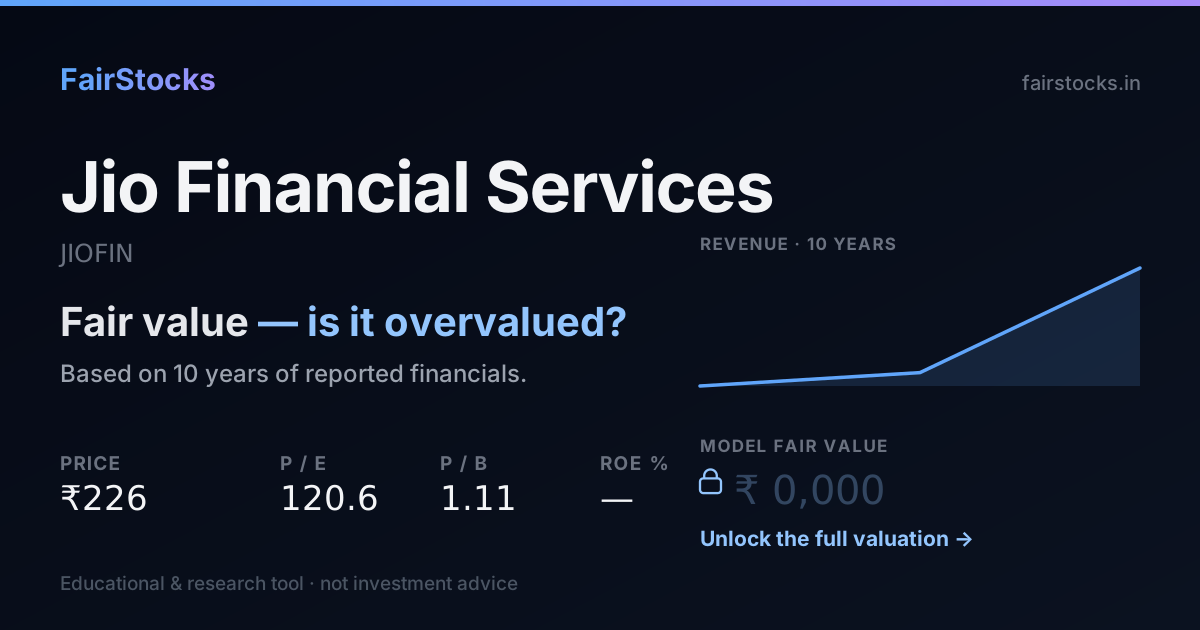
The market expects Jio Financial to carry on much as it has.
At today’s share price, buyers are assuming Jio Financial grows about 33% a year, forever. Over the last ten years it actually grew about 35% a year. The two are close, so the share price does not need the business to improve or to stumble. It needs it to keep doing roughly what it already does.
- How it is valued: Discounted cash flow.
- What the price assumes: 33% growth, against 35% the model takes from its own record.
- Biggest swing factor: Lending growth. Main risk: Execution.
01A new financial group from Reliance
Jio Financial Services was demerged from Reliance Industries and listed in August 2023. It runs Jio Credit (lending), Jio Payments Bank, Jio Leasing and an insurance broking arm, and has joint ventures with BlackRock in asset management, wealth and broking.
It started with a large capital base, part of it held as shares in Reliance Industries. Its businesses are young, so reported profit today says little about what the group could earn at scale.
02What the market is assuming
Work backwards from today's share price and you can see what buyers are quietly taking for granted. Here is the growth that price implies for Jio Financial, next to what the model assumes from the company's own record.
The further apart these two numbers are, the bigger the bet a buyer at today's price is making.
03Jio Financial's record, in plain numbers
Revenue and earnings per share in ₹, return on equity and leverage as ratios — all from the filed statements.
Revenue and net profit by year (₹ crore)
| Year | Revenue | Net profit | Margin |
|---|---|---|---|
| FY2024 | 1,854 | 1,605 | 86.6% |
| FY2025 | 2,043 | 1,613 | 78.9% |
| FY2026 | 3,513 | 1,561 | 44.4% |
04How Jio Financial gets valued — and why
Discounted cash flowThis business is valued on the cash it is expected to generate, discounted back at its cost of capital — with growth taken from its own ten-year record rather than from guidance.
05What decides Jio Financial's value
Lending growth
How fast Jio Credit builds a profitable loan book.
BlackRock ventures
Mutual funds and broking need to win customers at scale.
Jio's reach
Access to Jio's huge customer base is the core advantage.
Capital use
Deploying its capital at good returns decides value.
06What could go wrong
- Execution. New financial businesses take years to become profitable.
- Competition. Banks and fintechs already serve its target customers.
- The premium. The price reflects ambitions not yet in the numbers.
07What the full Jio Financial valuation shows
Sign in free to see the complete Jio Financial valuation
- ✓Fair value per share — from a ten-year discounted cash flow, every step shown
- ✓The Workbench — change revenue growth, the discount rate or terminal growth and watch Jio Financial's value move
- ✓Bull, base and bear cases — and exactly which assumptions move between them
- ✓Peer comparison — against other Indian financial companies
- ✓Downloadable report — the full write-up, yours to keep
08Questions people ask about Jio Financial
When was Jio Financial Services listed?
In August 2023, after being demerged from Reliance Industries.
What does Jio Financial do?
Lending, payments, leasing, insurance broking, and asset management and broking with BlackRock.
Why is Jio Financial's profit small compared with its value?
Its businesses are early-stage; the market is valuing what they could become.
Is Jio Financial overvalued?
At ₹226 the market is pricing in roughly 33% sustained growth, against the ~35% its own record supports. That is less than it has delivered — on these numbers the market is asking the business for less than its own record, which usually means it doubts the record repeats.
What is the intrinsic value of Jio Financial?
It is computed from the filed financial statements using the method that fits this business (discounted cash flow), with every assumption shown alongside the result. The per-share figure and the full working are in the report.
How much debt does Jio Financial carry?
Debt to equity stands at 0.12, against 0.00 at the start of the period — the balance sheet is a core input to the cost of capital used here.