On this page ▾
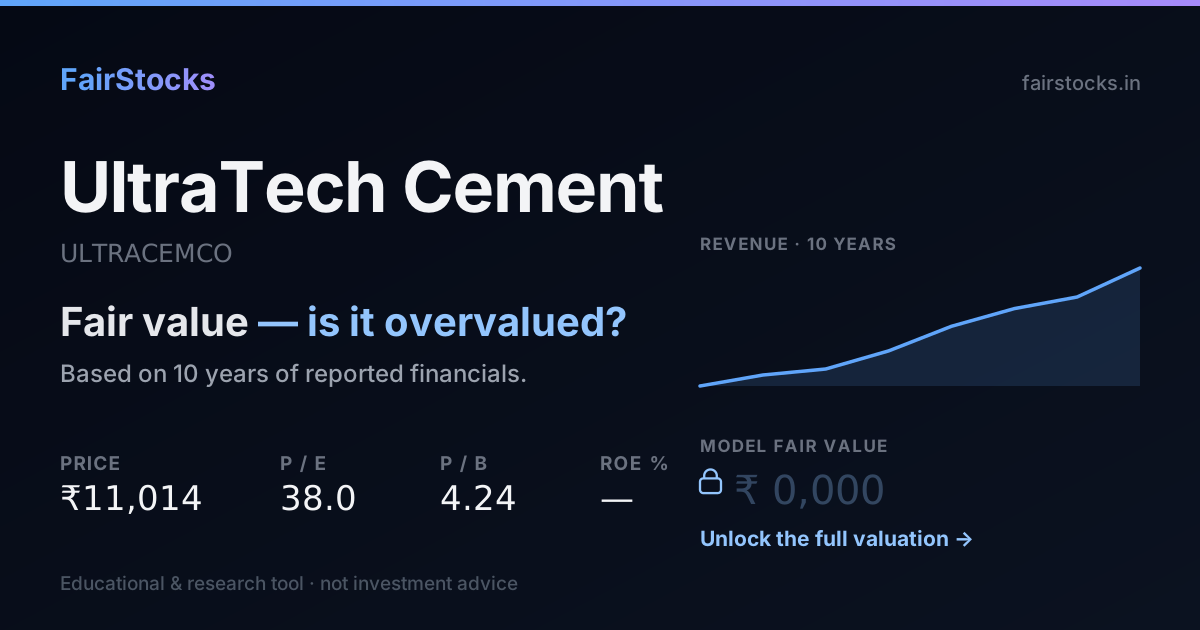
The market expects UltraTech Cement to do better than it ever has.
At today’s share price, buyers are assuming UltraTech Cement grows about 19% a year, forever. Over the last ten years it actually grew about 14% a year. So the share price only makes sense if the business improves on its own track record. If it simply carries on as before, buyers today have paid for something they will not get.
- How it is valued: Discounted cash flow.
- What the price assumes: 19% growth, against 14% the model takes from its own record.
- Ten-year record: Between FY2019 and FY2026, UltraTech Cement's revenue went from ₹37,379 crore to ₹88,512 crore — it compounded at about 13% a year over 7 years.
- Biggest swing factor: Cement prices. Main risk: A price war.
01The biggest cement maker in India
UltraTech Cement, part of the Aditya Birla group through Grasim Industries, is India's largest cement producer, with plants and grinding units across the country and a capacity well ahead of its nearest rival. It also sells ready-mix concrete and building products, and has announced a move into cables and wires.
Much of its growth has come from acquisitions, including India Cements and the cement business of Kesoram Industries. Cement is heavy and cheap to make but costly to move, so owning plants close to every major market is the industry's main advantage.
02What the market is assuming
Work backwards from today's share price and you can see what buyers are quietly taking for granted. Here is the growth that price implies for UltraTech Cement, next to what the model assumes from the company's own record.
The further apart these two numbers are, the bigger the bet a buyer at today's price is making.
03UltraTech Cement's record, in plain numbers
Between FY2019 and FY2026, UltraTech Cement's revenue went from ₹37,379 crore to ₹88,512 crore — it compounded at about 13% a year over 7 years. Net profit grew from ₹2,432 crore to ₹8,188 crore, about 19% a year — faster than revenue, so margins widened. In FY2026 it kept 9.3% of revenue as net profit — against a low of 6.5% in FY2019 and a high of 13.9% in FY2022. The latest year added 16.5% to revenue, well ahead of its own long-run pace.
Revenue and earnings per share in ₹, return on equity and leverage as ratios — all from the filed statements.
Revenue and net profit by year (₹ crore)
| Year | Revenue | Net profit | Margin |
|---|---|---|---|
| FY2019 | 37,379 | 2,432 | 6.5% |
| FY2020 | 42,125 | 5,810 | 13.8% |
| FY2021 | 44,726 | 5,462 | 12.2% |
| FY2022 | 52,599 | 7,334 | 13.9% |
| FY2023 | 63,240 | 5,073 | 8.0% |
| FY2024 | 70,908 | 7,004 | 9.9% |
| FY2025 | 75,955 | 6,040 | 8.0% |
| FY2026 | 88,512 | 8,188 | 9.3% |
04How UltraTech Cement gets valued — and why
Discounted cash flowThis business is valued on the cash it is expected to generate, discounted back at its cost of capital — with growth taken from its own ten-year record rather than from guidance.
05What decides UltraTech Cement's value
Cement prices
Realisation per tonne moves with regional demand and how disciplined producers are on price.
Capacity utilisation
Plants are expensive to build; running them closer to capacity lifts returns.
Fuel and freight costs
Coal, pet coke and diesel are big costs that the company does not control.
Acquisition returns
Bought plants need upgrading; value is created only if they earn more than the price paid.
06What could go wrong
- A price war. Rapid expansion by the Adani group's cement companies could pressure prices.
- Construction slowdowns. Weaker housing or government infrastructure spending cuts demand.
- Diversification. Cables and wires is a new business with different economics.
07What the full UltraTech valuation shows
Sign in free to see the complete UltraTech Cement valuation
- ✓Fair value per share — from a ten-year discounted cash flow, every step shown
- ✓The Workbench — change revenue growth, the discount rate or terminal growth and watch UltraTech's value move
- ✓Bull, base and bear cases — and exactly which assumptions move between them
- ✓Peer comparison — against Ambuja Cements, JSW Steel and Larsen & Toubro
- ✓Downloadable report — the full write-up, yours to keep
08Compare UltraTech Cement with peers
The same valuation, run side by side.
UltraTech Cement vs Larsen & ToubroCement sells into exactly the construction LT wins the contracts for.→UltraTech Cement vs JSW SteelThe two materials a building consumes most of, on the same capex cycle.→UltraTech Cement vs Ambuja CementsThe nearest listed cement comparison.→09Questions people ask about UltraTech Cement
Why does UltraTech keep buying other cement companies?
Building new plants takes years; buying existing ones adds capacity and market share immediately. The valuation tests whether the prices paid earn back their cost.
How does UltraTech make money?
By making and selling cement and concrete across India. Profit per tonne depends on regional prices, fuel costs and how fully its plants are used.
UltraTech or Ambuja Cements — which is better value?
Both are valued on the same cash-flow model; the comparison page sets them side by side on price, returns and what each share price assumes.
Is UltraTech Cement overvalued?
At ₹12,100 the market is pricing in roughly 19% sustained growth, against the ~14% its own record supports. That is more than it has delivered, so the price is justified only if the business can hold a rate it has not previously sustained.
What is the intrinsic value of UltraTech Cement?
It is computed from the filed financial statements using the method that fits this business (discounted cash flow), with every assumption shown alongside the result. The per-share figure and the full working are in the report.
How much debt does UltraTech Cement carry?
Debt to equity stands at 0.20, against 0.09 at the start of the period — the balance sheet is a core input to the cost of capital used here.