On this page ▾
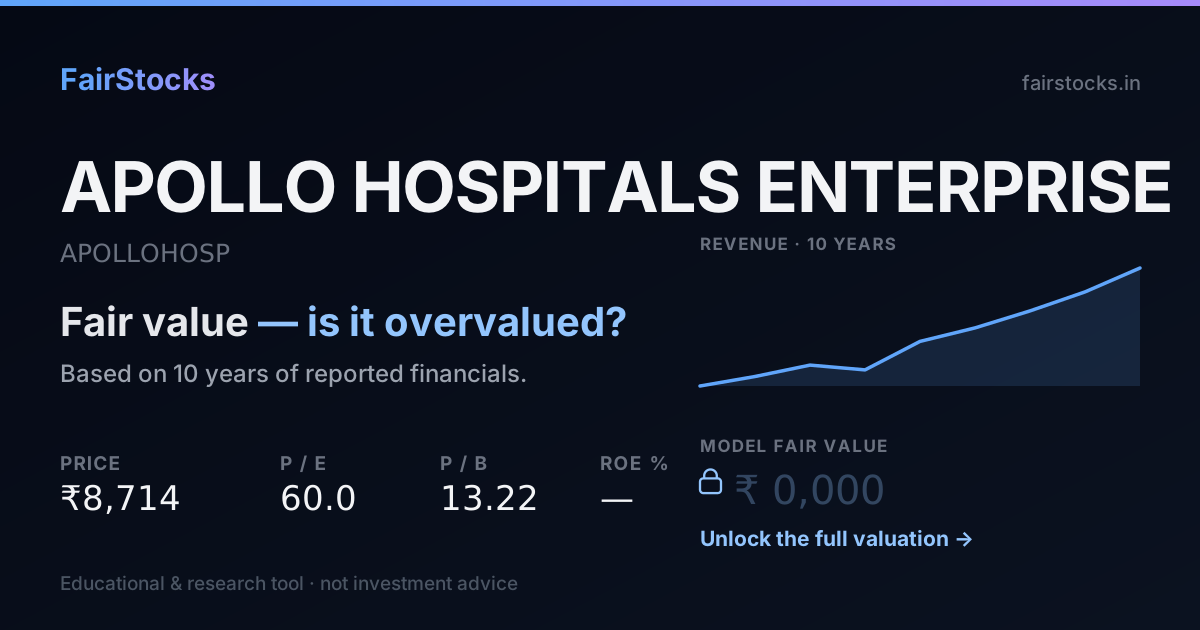
The market expects Apollo Hospitals to do better than it ever has.
At today’s share price, buyers are assuming Apollo Hospitals grows about 21% a year, forever. Over the last ten years it actually grew about 16% a year. So the share price only makes sense if the business improves on its own track record. If it simply carries on as before, buyers today have paid for something they will not get.
- How it is valued: Discounted cash flow.
- What the price assumes: 21% growth, against 16% the model takes from its own record.
- Ten-year record: Between FY2018 and FY2026, Apollo Hospitals' revenue went from ₹8,243 crore to ₹25,228 crore — it compounded at about 15% a year over 8 years.
- Biggest swing factor: Hospital occupancy and pricing. Main risk: Price regulation.
01India's largest private hospital group
Apollo Hospitals Enterprise was founded in Chennai in 1983 by Dr Prathap C. Reddy and opened one of India's first corporate hospitals. Today it runs a network of large multi-speciality hospitals across the country, along with clinics, diagnostics and day-care centres.
Apollo HealthCo runs its pharmacy chain — one of the largest in India — and the Apollo 24|7 digital health platform. Hospitals earn high returns once beds fill; the pharmacy and digital businesses are larger by revenue but earn thinner margins.
02What the market is assuming
Work backwards from today's share price and you can see what buyers are quietly taking for granted. Here is the growth that price implies for Apollo Hospitals, next to what the model assumes from the company's own record.
The further apart these two numbers are, the bigger the bet a buyer at today's price is making.
03Apollo Hospitals' record, in plain numbers
Between FY2018 and FY2026, Apollo Hospitals' revenue went from ₹8,243 crore to ₹25,228 crore — it compounded at about 15% a year over 8 years. Net profit grew from ₹60 crore to ₹2,003 crore, about 55% a year — faster than revenue, so margins widened. In FY2026 it kept 7.9% of revenue as net profit — its best year in the period. The latest year added 15.8% to revenue, close to its own long-run pace.
Revenue and earnings per share in ₹, return on equity and leverage as ratios — all from the filed statements.
Revenue and net profit by year (₹ crore)
| Year | Revenue | Net profit | Margin |
|---|---|---|---|
| FY2018 | 8,243 | 60 | 0.7% |
| FY2019 | 9,617 | 200 | 2.1% |
| FY2020 | 11,247 | 432 | 3.8% |
| FY2021 | 10,560 | 137 | 1.3% |
| FY2022 | 14,663 | 1,108 | 7.6% |
| FY2023 | 16,612 | 845 | 5.1% |
| FY2024 | 19,059 | 935 | 4.9% |
| FY2025 | 21,794 | 1,505 | 6.9% |
| FY2026 | 25,228 | 2,003 | 7.9% |
04How Apollo Hospitals gets valued — and why
Discounted cash flowThis business is valued on the cash it is expected to generate, discounted back at its cost of capital — with growth taken from its own ten-year record rather than from guidance.
05What decides Apollo Hospitals' value
Hospital occupancy and pricing
Fuller beds and more complex procedures lift margins.
New beds
Apollo is adding capacity; new hospitals take years to mature.
Pharmacy and digital
Reaching steady profit in Apollo 24|7 would add real value.
Medical tourism
International patients pay more and add high-margin revenue.
06What could go wrong
- Price regulation. Caps on treatment or drug prices would squeeze margins.
- Expansion costs. New hospitals lose money before they fill up.
- Doctor costs. Competition for senior doctors raises salaries.
07What the full Apollo Hospitals valuation shows
Sign in free to see the complete Apollo Hospitals valuation
- ✓Fair value per share — from a ten-year discounted cash flow, every step shown
- ✓The Workbench — change revenue growth, the discount rate or terminal growth and watch Apollo's value move
- ✓Bull, base and bear cases — and exactly which assumptions move between them
- ✓Peer comparison — against Max Healthcare, Sun Pharma and Cipla
- ✓Downloadable report — the full write-up, yours to keep
08Compare Apollo Hospitals with peers
The same valuation, run side by side.
Apollo Hospitals vs Sun PharmaDelivering healthcare against manufacturing the medicine.→Apollo Hospitals vs CiplaHospitals and pharmacies against a drug maker.→Apollo Hospitals vs Max HealthcareThe nearest listed hospital-chain comparison.→09Questions people ask about Apollo Hospitals
How does Apollo Hospitals make money?
Mostly from hospital treatment, plus its pharmacies, diagnostics and the Apollo 24|7 digital platform.
Who founded Apollo Hospitals?
Dr Prathap C. Reddy, who opened the first Apollo hospital in Chennai in 1983.
Apollo or Max Healthcare — which is better value?
The two largest listed hospital chains, compared side by side on their own page.
Is Apollo Hospitals overvalued?
At ₹8,526 the market is pricing in roughly 21% sustained growth, against the ~16% its own record supports. That is more than it has delivered, so the price is justified only if the business can hold a rate it has not previously sustained.
What is the intrinsic value of Apollo Hospitals?
It is computed from the filed financial statements using the method that fits this business (discounted cash flow), with every assumption shown alongside the result. The per-share figure and the full working are in the report.
How much debt does Apollo Hospitals carry?
Debt to equity stands at 0.26, down from 0.32 at the start of the period — the balance sheet is a core input to the cost of capital used here.