On this page ▾
The market expects much less from Coal India than it has delivered before.
At today’s share price, buyers are assuming Coal India grows about 0% a year, forever. Over the last ten years it actually grew about 10% a year. That is a big step down from its own record — in other words, that it stops growing altogether. Either the market can see a problem that the published accounts do not show yet, or it is expecting a slowdown that has not happened.
- How it is valued: Discounted cash flow.
- What the price assumes: 0% growth, against 10% the model takes from its own record.
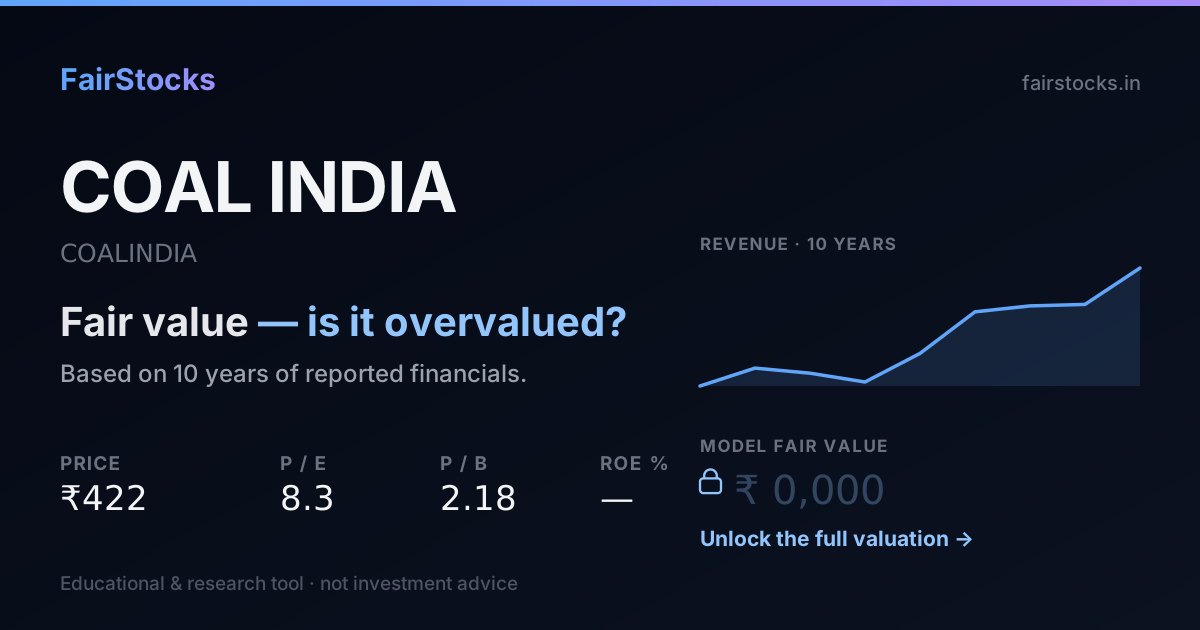
- Ten-year record: Between FY2018 and FY2026, Coal India's revenue went from ₹87,269 crore to ₹1,68,400 crore — it compounded at about 9% a year over 8 years.
- Biggest swing factor: Volumes. Main risk: Energy transition.
01Most of India's coal, from one company
Coal India is the world's largest coal producer by output and is majority-owned by the Government of India. Through subsidiaries such as Mahanadi Coalfields, South Eastern Coalfields and Northern Coalfields, it produces roughly three-quarters of the coal mined in India.
Most of its coal goes to power stations under long-term fuel supply agreements at prices it sets, with the rest sold through e-auctions at market prices. It needs relatively little capital and pays out a large share of profit as dividends.
02What the market is assuming
Work backwards from today's share price and you can see what buyers are quietly taking for granted. Here is the growth that price implies for Coal India, next to what the model assumes from the company's own record.
The further apart these two numbers are, the bigger the bet a buyer at today's price is making.
03Coal India's record, in plain numbers
Between FY2018 and FY2026, Coal India's revenue went from ₹87,269 crore to ₹1,68,400 crore — it compounded at about 9% a year over 8 years. Net profit grew from ₹7,020 crore to ₹31,071 crore, about 20% a year — faster than revenue, so margins widened. In FY2026 it kept 18.5% of revenue as net profit — against a low of 8.0% in FY2018 and a high of 26.3% in FY2024. The latest year added 17.5% to revenue, well ahead of its own long-run pace.
Revenue and earnings per share in ₹, return on equity and leverage as ratios — all from the filed statements.
Revenue and net profit by year (₹ crore)
| Year | Revenue | Net profit | Margin |
|---|---|---|---|
| FY2018 | 87,269 | 7,020 | 8.0% |
| FY2019 | 99,547 | 17,462 | 17.5% |
| FY2020 | 96,080 | 16,700 | 17.4% |
| FY2021 | 90,026 | 12,702 | 14.1% |
| FY2022 | 1,09,714 | 17,378 | 15.8% |
| FY2023 | 1,38,252 | 28,125 | 20.3% |
| FY2024 | 1,42,324 | 37,369 | 26.3% |
| FY2025 | 1,43,369 | 35,302 | 24.6% |
| FY2026 | 1,68,400 | 31,071 | 18.5% |
04How Coal India gets valued — and why
Discounted cash flowThis business is valued on the cash it is expected to generate, discounted back at its cost of capital — with growth taken from its own ten-year record rather than from guidance.
05What decides Coal India's value
Volumes
India's power demand still leans heavily on coal, so output has kept growing.
E-auction premiums
Coal sold at auction earns far more than contract coal; the premium swings with demand and imported-coal prices.
Notified prices
Price increases on contract coal are infrequent and politically sensitive.
Employee costs
Wage settlements are a major cost.
06What could go wrong
- Energy transition. Over the long term, renewables will reduce coal demand.
- Private and captive mining. More coal mined by others reduces Coal India's share.
- Policy. Pricing and dividend decisions are influenced by the government as majority owner.
07What the full Coal India valuation shows
Sign in free to see the complete Coal India valuation
- ✓Fair value per share — from a ten-year discounted cash flow, every step shown
- ✓The Workbench — change revenue growth, the discount rate or terminal growth and watch Coal India's value move
- ✓Bull, base and bear cases — and exactly which assumptions move between them
- ✓Peer comparison — against NTPC, ONGC and Power Grid
- ✓Downloadable report — the full write-up, yours to keep
08Compare Coal India with peers
The same valuation, run side by side.
Coal India vs NTPCThe miner against its largest single customer.→Coal India vs ONGCBoth state-controlled energy, one digging coal and one drilling oil.→Coal India vs Power GridTwo state-owned links in the same power chain.→09Questions people ask about Coal India
Why does Coal India pay such high dividends?
It generates a lot of cash and needs relatively little capital, and its majority owner, the government, relies on those dividends.
Will coal demand in India keep growing?
For now, yes — power demand is rising and coal still supplies most of it. The long-term path depends on how fast renewables and storage scale.
Coal India or NTPC — which is better value?
The miner and its largest customer are compared side by side on their own page.
Is Coal India overvalued?
At ₹404 the market is pricing in roughly 0% sustained growth, against the ~10% its own record supports. That is less than it has delivered — on these numbers the market is asking the business for less than its own record, which usually means it doubts the record repeats.
What is the intrinsic value of Coal India?
It is computed from the filed financial statements using the method that fits this business (discounted cash flow), with every assumption shown alongside the result. The per-share figure and the full working are in the report.