On this page ▾
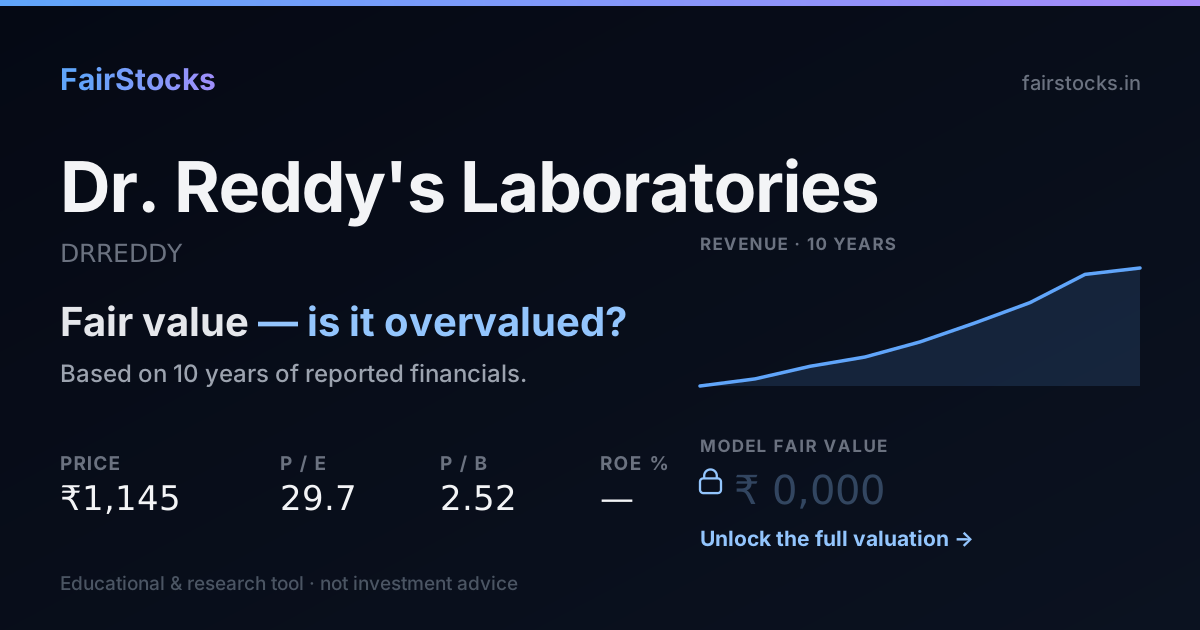
The market expects much less from Dr Reddy's than it has delivered before.
At today’s share price, buyers are assuming Dr Reddy's grows about 0% a year, forever. Over the last ten years it actually grew about 13% a year. That is a big step down from its own record — in other words, that it stops growing altogether. Either the market can see a problem that the published accounts do not show yet, or it is expecting a slowdown that has not happened.
- How it is valued: Discounted cash flow.
- What the price assumes: 0% growth, against 13% the model takes from its own record.
- Ten-year record: Between FY2018 and FY2026, Dr Reddy's revenue went from ₹14,281 crore to ₹33,700 crore — it compounded at about 11% a year over 8 years.
- Biggest swing factor: Replacing Revlimid. Main risk: FDA inspections.
01A Hyderabad generics maker with a global footprint
Dr Reddy's Laboratories was founded in Hyderabad in 1984 by Dr K. Anji Reddy. It makes generic medicines for the US, India, Russia and other emerging markets, and active pharmaceutical ingredients that it sells to other drugmakers.
For several years it earned large profits from a limited-volume US generic of the cancer drug Revlimid, an arrangement that ran out when the market opened fully in 2026. It has since added consumer-health businesses, including nicotine-replacement brands bought from Haleon, and a nutrition joint venture with Nestle India.
02What the market is assuming
Work backwards from today's share price and you can see what buyers are quietly taking for granted. Here is the growth that price implies for Dr Reddy's, next to what the model assumes from the company's own record.
The further apart these two numbers are, the bigger the bet a buyer at today's price is making.
03Dr Reddy's record, in plain numbers
Between FY2018 and FY2026, Dr Reddy's revenue went from ₹14,281 crore to ₹33,700 crore — it compounded at about 11% a year over 8 years. Net profit grew from ₹947 crore to ₹4,158 crore, about 20% a year — faster than revenue, so margins widened. In FY2026 it kept 12.3% of revenue as net profit — against a low of 6.6% in FY2018 and a high of 19.9% in FY2024. The latest year added 3.2% to revenue, well behind its own long-run pace.
Revenue and earnings per share in ₹, return on equity and leverage as ratios — all from the filed statements.
Revenue and net profit by year (₹ crore)
| Year | Revenue | Net profit | Margin |
|---|---|---|---|
| FY2018 | 14,281 | 947 | 6.6% |
| FY2019 | 15,448 | 1,950 | 12.6% |
| FY2020 | 17,517 | 2,026 | 11.6% |
| FY2021 | 19,048 | 1,952 | 10.2% |
| FY2022 | 21,545 | 2,182 | 10.1% |
| FY2023 | 24,670 | 4,507 | 18.3% |
| FY2024 | 28,011 | 5,578 | 19.9% |
| FY2025 | 32,644 | 5,725 | 17.5% |
| FY2026 | 33,700 | 4,158 | 12.3% |
04How Dr Reddy's gets valued — and why
Discounted cash flowThis business is valued on the cash it is expected to generate, discounted back at its cost of capital — with growth taken from its own ten-year record rather than from guidance.
05What decides Dr Reddy's value
Replacing Revlimid
New US launches and other markets need to fill the gap left by one very profitable product.
US generic pricing
Prices for older generics keep falling, so the pipeline has to keep moving.
Emerging markets and India
Branded sales in India and Russia are steadier and grow with those markets.
Consumer health
New consumer brands add growth at different margins from prescription drugs.
06What could go wrong
- FDA inspections. Adverse findings at a plant can block US approvals and shipments.
- Pipeline delays. Late approvals push out the launches that replace lost profit.
- Currency and Russia. Rouble swings and sanctions risk affect a meaningful market.
07What the full Dr Reddy's valuation shows
Sign in free to see the complete Dr Reddy's valuation
- ✓Fair value per share — from a ten-year discounted cash flow, every step shown
- ✓The Workbench — change revenue growth, the discount rate or terminal growth and watch Dr Reddy's value move
- ✓Bull, base and bear cases — and exactly which assumptions move between them
- ✓Peer comparison — against Sun Pharma, Cipla and Divi's Laboratories
- ✓Downloadable report — the full write-up, yours to keep
08Compare Dr Reddy's with peers
The same valuation, run side by side.
Dr Reddy's vs Sun PharmaThe largest Indian pharma, on the same US-generics swing.→Dr Reddy's vs CiplaA more India-and-emerging-markets weighted book.→Dr Reddy's vs Divi's LaboratoriesBranded generics against contract manufacturing.→09Questions people ask about Dr Reddy's
Why did Dr Reddy's profit fall in FY2026?
Mainly because sales of its limited-volume US generic of Revlimid wound down as the market opened to full competition.
What is Dr Reddy's biggest market?
North America, mainly US generics, followed by India, Russia and other emerging markets.
Dr Reddy's or Sun Pharma — which is better value?
Both are valued on the same cash-flow model; the comparison page sets them side by side.
Is Dr Reddy's overvalued?
At ₹1,380 the market is pricing in roughly 0% sustained growth, against the ~13% its own record supports. That is less than it has delivered — on these numbers the market is asking the business for less than its own record, which usually means it doubts the record repeats.
What is the intrinsic value of Dr Reddy's?
It is computed from the filed financial statements using the method that fits this business (discounted cash flow), with every assumption shown alongside the result. The per-share figure and the full working are in the report.
How much debt does Dr Reddy's carry?
Debt to equity stands at 0.00, down from 0.01 at the start of the period — the balance sheet is a core input to the cost of capital used here.