On this page ▾
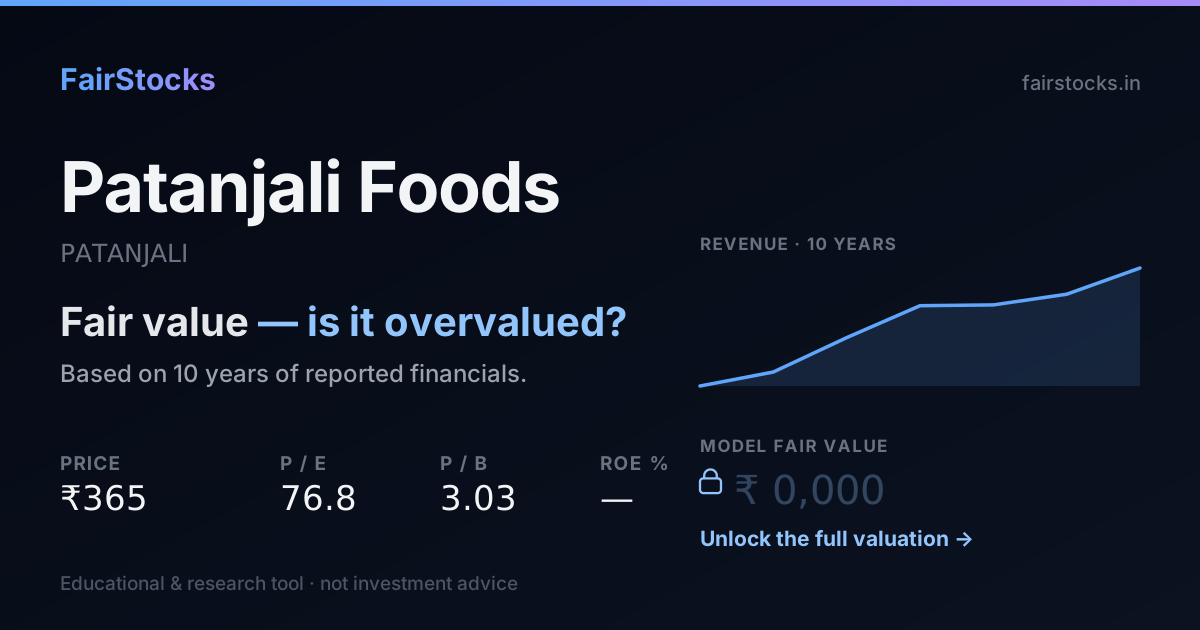
The market expects Patanjali Foods to do better than it ever has.
At today’s share price, buyers are assuming Patanjali Foods grows about 18% a year, forever. Over the last ten years it actually grew about 13% a year. So the share price only makes sense if the business improves on its own track record. If it simply carries on as before, buyers today have paid for something they will not get.
- How it is valued: Discounted cash flow.
- What the price assumes: 18% growth, against 13% the model takes from its own record.
- Ten-year record: Between FY2021 and FY2026, Patanjali Foods' revenue went from ₹16,319 crore to ₹40,170 crore — it compounded at about 20% a year over 5 years.
- Biggest swing factor: Edible oil margins. Main risk: Commodity volatility.
01Edible oils to branded consumer goods
Patanjali Foods was formerly Ruchi Soya, which Patanjali Ayurved acquired through the insolvency process in 2019 and renamed in 2022. Edible oils — Ruchi Gold, Mahakosh, Nutrela soya chunks — still make up most of its revenue.
It has since taken over Patanjali's biscuits, noodles and other foods and, in 2025, its home and personal-care business, to become a broader consumer-goods company.
02What the market is assuming
Work backwards from today's share price and you can see what buyers are quietly taking for granted. Here is the growth that price implies for Patanjali Foods, next to what the model assumes from the company's own record.
The further apart these two numbers are, the bigger the bet a buyer at today's price is making.
03Patanjali Foods' record, in plain numbers
Between FY2021 and FY2026, Patanjali Foods' revenue went from ₹16,319 crore to ₹40,170 crore — it compounded at about 20% a year over 5 years. Net profit grew from ₹681 crore to ₹1,814 crore, about 22% a year — faster than revenue, so margins widened. In FY2026 it kept 4.5% of revenue as net profit — its best year in the period. The latest year added 17.6% to revenue, close to its own long-run pace.
Revenue and earnings per share in ₹, return on equity and leverage as ratios — all from the filed statements.
Revenue and net profit by year (₹ crore)
| Year | Revenue | Net profit | Margin |
|---|---|---|---|
| FY2020 | 13,118 | 7,672 | 58.5% |
| FY2021 | 16,319 | 681 | 4.2% |
| FY2022 | 24,205 | 806 | 3.3% |
| FY2023 | 31,525 | 886 | 2.8% |
| FY2024 | 31,721 | 765 | 2.4% |
| FY2025 | 34,157 | 1,301 | 3.8% |
| FY2026 | 40,170 | 1,814 | 4.5% |
04How Patanjali Foods gets valued — and why
Discounted cash flowThis business is valued on the cash it is expected to generate, discounted back at its cost of capital — with growth taken from its own ten-year record rather than from guidance.
05What decides Patanjali Foods' value
Edible oil margins
Palm and soy oil prices swing profit.
Branded foods
Higher-margin foods lift the mix.
Home and personal care
The new business must integrate profitably.
Distribution
Patanjali's reach drives volumes.
06What could go wrong
- Commodity volatility. Oil prices can move sharply.
- Brand reputation. Patanjali's brand has faced regulatory controversies.
- Related-party deals. Transactions with the promoter group draw scrutiny.
07What the full Patanjali Foods valuation shows
Sign in free to see the complete Patanjali Foods valuation
- ✓Fair value per share — from a ten-year discounted cash flow, every step shown
- ✓The Workbench — change revenue growth, the discount rate or terminal growth and watch Patanjali Foods' value move
- ✓Bull, base and bear cases — and exactly which assumptions move between them
- ✓Peer comparison — against Marico, Dabur and other consumer companies
- ✓Downloadable report — the full write-up, yours to keep
08Questions people ask about Patanjali Foods
Is Patanjali Foods the same as Ruchi Soya?
Yes. Ruchi Soya was renamed Patanjali Foods in 2022.
What does Patanjali Foods sell?
Edible oils, soya foods, biscuits, noodles and home and personal-care products.
Who controls Patanjali Foods?
Patanjali Ayurved, the group associated with Baba Ramdev and Acharya Balkrishna.
Is Patanjali Foods overvalued?
At ₹421 the market is pricing in roughly 18% sustained growth, against the ~13% its own record supports. That is more than it has delivered, so the price is justified only if the business can hold a rate it has not previously sustained.
What is the intrinsic value of Patanjali Foods?
It is computed from the filed financial statements using the method that fits this business (discounted cash flow), with every assumption shown alongside the result. The per-share figure and the full working are in the report.
How much debt does Patanjali Foods carry?
Debt to equity stands at 0.00, down from 0.01 at the start of the period — the balance sheet is a core input to the cost of capital used here.