On this page ▾
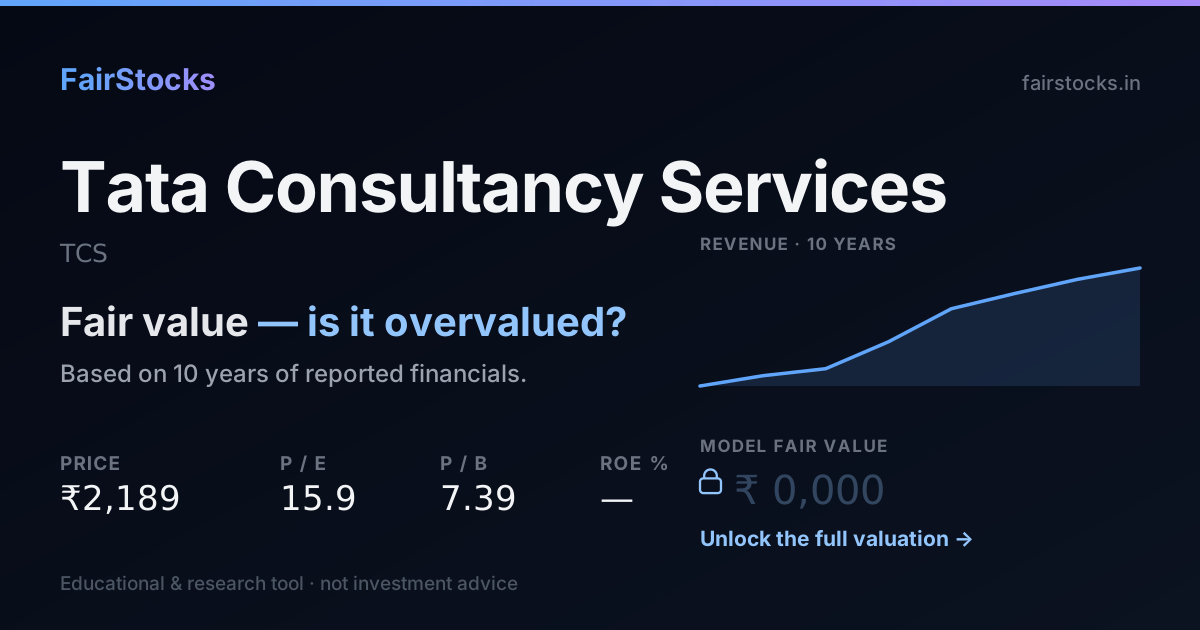
The market expects much less from Tata Consultancy Services than it has delivered before.
At today’s share price, buyers are assuming Tata Consultancy Services grows about 0% a year, forever. Over the last ten years it actually grew about 7% a year. That is a big step down from its own record — in other words, that it stops growing altogether. Either the market can see a problem that the published accounts do not show yet, or it is expecting a slowdown that has not happened.
- How it is valued: Discounted cash flow.
- What the price assumes: 0% growth, against 7% the model takes from its own record.
- Ten-year record: Between FY2019 and FY2026, Tata Consultancy Services' revenue went from ₹1,46,463 crore to ₹2,67,021 crore — it compounded at about 9% a year over 7 years.
- Biggest swing factor: Growth in constant currency. Main risk: Client budget cuts.
01How TCS makes its money
Tata Consultancy Services is India's largest IT services company and part of the Tata group, which holds the majority of its shares. It builds and runs software, cloud and data systems for large companies around the world, with banking and financial services its biggest industry and North America its largest market.
The model is asset-light: the main cost is people, and contracts run for years. That makes TCS one of the most predictable cash generators in Indian markets — and it means the valuation is almost entirely about growth and margins, not the balance sheet.
02What the market is assuming
Work backwards from today's share price and you can see what buyers are quietly taking for granted. Here is the growth that price implies for Tata Consultancy Services, next to what the model assumes from the company's own record.
The further apart these two numbers are, the bigger the bet a buyer at today's price is making.
03Tata Consultancy Services' record, in plain numbers
Between FY2019 and FY2026, Tata Consultancy Services' revenue went from ₹1,46,463 crore to ₹2,67,021 crore — it compounded at about 9% a year over 7 years. Net profit grew from ₹31,562 crore to ₹49,454 crore, about 7% a year — slower than revenue, so margins narrowed. Net margin has been unusually stable, between 18.5% and 21.5% in every year shown. The latest year added 4.6% to revenue, well behind its own long-run pace.
Revenue and earnings per share in ₹, return on equity and leverage as ratios — all from the filed statements.
Revenue and net profit by year (₹ crore)
| Year | Revenue | Net profit | Margin |
|---|---|---|---|
| FY2019 | 1,46,463 | 31,562 | 21.5% |
| FY2020 | 1,56,949 | 32,447 | 20.7% |
| FY2021 | 1,64,177 | 32,562 | 19.8% |
| FY2022 | 1,91,754 | 38,449 | 20.1% |
| FY2023 | 2,25,458 | 42,303 | 18.8% |
| FY2024 | 2,40,893 | 46,099 | 19.1% |
| FY2025 | 2,55,324 | 48,797 | 19.1% |
| FY2026 | 2,67,021 | 49,454 | 18.5% |
04How Tata Consultancy Services gets valued — and why
Discounted cash flowThis business is valued on the cash it is expected to generate, discounted back at its cost of capital — with growth taken from its own ten-year record rather than from guidance.
05What decides Tata Consultancy Services' value
Growth in constant currency
TCS earns mostly in dollars, pounds and euros. Constant-currency growth shows how demand is holding up; the rupee then adds to or subtracts from it.
Operating margin
TCS has held one of the highest margins in the industry. On revenue this size, every point of margin is worth thousands of crores of profit.
AI and pricing
Generative AI lowers the cost of delivering services — good for margins if TCS keeps the savings, bad for revenue if clients demand them back.
Payout
TCS returns most of its profit as dividends and buybacks, so value to shareholders tracks free cash flow closely.
06What could go wrong
- Client budget cuts. Banks and retailers in the US and Europe trim discretionary IT spending first in a downturn.
- Visa and immigration costs. Higher costs for US work visas make onsite delivery more expensive.
- Wages and attrition. Salary inflation and staff turnover eat into margins when demand for talent heats up.
07What the full TCS valuation shows
Sign in free to see the complete Tata Consultancy Services valuation
- ✓Fair value per share — from a ten-year discounted cash flow, every step shown
- ✓The Workbench — change revenue growth, the discount rate or terminal growth and watch TCS's value move
- ✓Bull, base and bear cases — and exactly which assumptions move between them
- ✓Peer comparison — against Infosys, HCLTech and Wipro on the same cash-flow model
- ✓Downloadable report — the full write-up, yours to keep
08Compare Tata Consultancy Services with peers
The same valuation, run side by side.
Tata Consultancy Services vs InfosysThe two largest Indian IT services firms, on the same cash-flow model.→Tata Consultancy Services vs HCL TechnologiesSimilar mix, historically a different margin profile.→Tata Consultancy Services vs WiproThe third of the large-cap IT set, on a smaller base.→09Questions people ask about Tata Consultancy Services
Why is TCS valued with a DCF?
TCS is a cash-generative services business with little debt and steady capital needs — exactly what a discounted cash flow handles well. Growth is taken from its own record, not from management guidance.
Is TCS better value than Infosys?
Both are valued on the same cash-flow model, so the comparison is like for like. The TCS vs Infosys page sets them side by side; the full valuation gives each one's fair value.
How does the rupee affect TCS?
A weaker rupee lifts reported revenue and margins, because most costs are in rupees and most revenue is not. The model works from reported rupee figures, so currency moves are already in the ten-year record.
Is Tata Consultancy Services overvalued?
At ₹2,408 the market is pricing in roughly 0% sustained growth, against the ~7% its own record supports. That is less than it has delivered — on these numbers the market is asking the business for less than its own record, which usually means it doubts the record repeats.
What is the intrinsic value of Tata Consultancy Services?
It is computed from the filed financial statements using the method that fits this business (discounted cash flow), with every assumption shown alongside the result. The per-share figure and the full working are in the report.
How much debt does Tata Consultancy Services carry?
Debt to equity stands at 0.00, against 0.00 at the start of the period — the balance sheet is a core input to the cost of capital used here.