On this page ▾
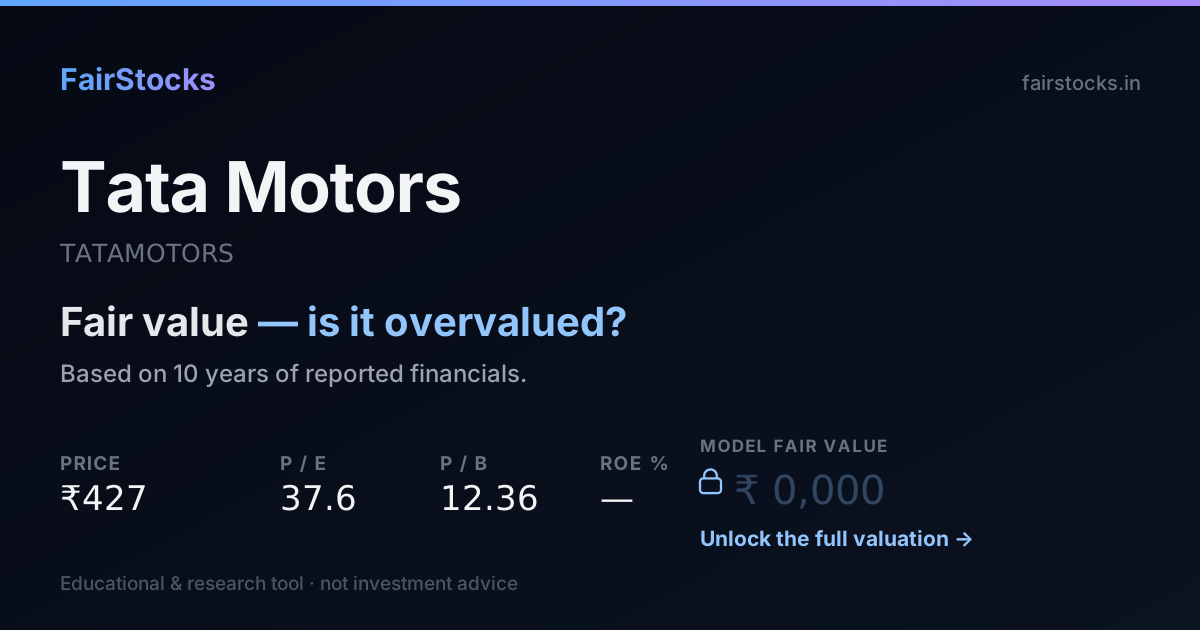
The market expects Tata Motors to do better than it ever has.
At today’s share price, buyers are assuming Tata Motors grows about 16% a year, forever. Over the last ten years it actually grew about 8% a year. So the share price only makes sense if the business improves on its own track record. If it simply carries on as before, buyers today have paid for something they will not get.
- How it is valued: Discounted cash flow.
- What the price assumes: 16% growth, against 8% the model takes from its own record.
- Biggest swing factor: Truck cycle. Main risk: Cyclical downturns.
01India's largest commercial-vehicle maker
The listed company now called Tata Motors is the commercial-vehicle business demerged in 2025 from the old Tata Motors. It is India's largest maker of trucks and buses, from small cargo vehicles such as the Ace to heavy trucks, and sells across South Asia, the Middle East and Africa.
The passenger-vehicle, electric-car and Jaguar Land Rover businesses now sit in a separately listed company, Tata Motors Passenger Vehicles. In 2025 the commercial-vehicle company agreed to buy Italy's Iveco Group, which would make it a global truck maker.
02What the market is assuming
Work backwards from today's share price and you can see what buyers are quietly taking for granted. Here is the growth that price implies for Tata Motors, next to what the model assumes from the company's own record.
The further apart these two numbers are, the bigger the bet a buyer at today's price is making.
03Tata Motors' record, in plain numbers
Revenue and net profit by year (₹ crore)
| Year | Revenue | Net profit | Margin |
|---|---|---|---|
| FY2026 | 83,855 | 3,030 | 3.6% |
04How Tata Motors gets valued — and why
Discounted cash flowThis business is valued on the cash it is expected to generate, discounted back at its cost of capital — with growth taken from its own ten-year record rather than from guidance.
05What decides Tata Motors' value
Truck cycle
Freight demand, infrastructure spending and interest rates drive sales.
Market share
Holding its lead against Ashok Leyland, Eicher and Mahindra.
Iveco
Integrating a large European truck maker would transform its scale and risk.
Margins
Pricing discipline and lower costs lift profit per truck.
06What could go wrong
- Cyclical downturns. Truck sales can fall sharply.
- Acquisition risk. A large overseas deal brings debt and integration challenges.
- Emission and EV rules. New norms raise costs and require investment.
07What the full Tata Motors valuation shows
Sign in free to see the complete Tata Motors valuation
- ✓Fair value per share — from a ten-year discounted cash flow, every step shown
- ✓The Workbench — change revenue growth, the discount rate or terminal growth and watch Tata Motors' value move
- ✓Bull, base and bear cases — and exactly which assumptions move between them
- ✓Peer comparison — against Ashok Leyland, Eicher Motors and Mahindra & Mahindra
- ✓Downloadable report — the full write-up, yours to keep
08Compare Tata Motors with peers
The same valuation, run side by side.
Tata Motors vs Eicher MotorsTrucks and buses against Eicher's VECV truck venture and Royal Enfield.→Tata Motors vs Mahindra & MahindraCommercial vehicles head to head, with M&M also in SUVs and tractors.→Tata Motors vs Maruti SuzukiIndia's largest truck maker against its largest car maker.→09Questions people ask about Tata Motors
What happened to Tata Motors in 2025?
It demerged: the passenger-vehicle and JLR business became Tata Motors Passenger Vehicles, and the truck and bus business kept the Tata Motors name.
Does Tata Motors still own Jaguar Land Rover?
No; JLR sits with Tata Motors Passenger Vehicles after the demerger.
What is the Iveco deal?
In 2025 the commercial-vehicle company agreed to buy Italy's Iveco Group.
Is Tata Motors overvalued?
At ₹453 the market is pricing in roughly 16% sustained growth, against the ~8% its own record supports. That is more than it has delivered, so the price is justified only if the business can hold a rate it has not previously sustained.
What is the intrinsic value of Tata Motors?
It is computed from the filed financial statements using the method that fits this business (discounted cash flow), with every assumption shown alongside the result. The per-share figure and the full working are in the report.